



Welcome to the year 2026.
And to kick it off, we wanted to do this piece for a while. It literally took weeks of work to stitch it all together 😀
Thing is, we moved to Substack in 2025, and figured this is the time to look back and cover all our effort on here in one piece.
If you read any piece of ours, were with us from day 1, or just landed here, we appreciate you! And hopefully, this one piece shows you the amount of effort we’re putting behind this passion-driven initiative.
So strap in, this will be a long one, and we hope you come out of it learning something new.
Every year-in-review risks the same trap: over-celebration of milestones that only matter internally, or forced reflection that reads like performance.
This isn’t that.
SK NEXUS is still small. Our subscriber count won’t impress anyone running a media company. Our traffic is modest. We don’t have venture backing or a growth team.
But we do have something worth documenting: a year where we figured out what we’re actually building, and who we’re building it for.
This review exists for two reasons:
First, to show our readers what they made possible. Every comment, share, and subscription validated that this work matters. You’ll see that reflected throughout.
Second, to be honest about what worked and what didn’t. Small publications survive by learning fast, and transparency compounds learning.
If you’ve been reading SK NEXUS this year, thank you. If you’re new, this is your introduction to how we think and operate.
First, a small origin story
How SK NEXUS Started 2025
At the start of 2025, SK NEXUS was in transition.
We had published articles scattered across our own website, and various platforms. Our average monthly readership sat around 3,000-4,000 views - respectable for a side project, invisible by normal standards. To add on top, these views don’t mean much when there was no way to know the people behind them.
More importantly, we were fragmented. Articles existed in silos. Readers couldn’t follow us easily. There was no central hub, no consistent publishing rhythm, no clear identity beyond “Pakistani tech commentary”.
The writing was solid. The intent was there. But the infrastructure wasn’t.
That’s why we migrated to Substack in early 2025.
Why Substack?
The decision was largely pragmatic:
Email-first distribution meant we could build direct relationships with readers instead of fighting algorithms.
Simplicity meant we could focus on writing, not managing CMS tools or worrying about hosting.
Built-in community features gave us comments, reactions, and engagement loops without custom development.
Credibility came from being on a platform known for serious, independent writers.
But the real reason was control.
Substack gave us ownership of our audience. No one could change the rules or de-platform us overnight.
This means that down the road if we do have to make the switch again, we have a way to do so.
Thanks Substack for allowing this functionality!
What We Were Trying to Build
Going into 2025, our mission was clear: make global tech legible for Pakistani audiences. And it turned out, that applied to the general consumer outside of Pakistan as well, so we adapted.
We worked on:
Explaining complex tech trends (AI, quantum, digital infrastructure) without assuming prior knowledge or deep context
Covering local angles on global stories (gaming economics, device affordability, privacy threats)
Writing for curious readers, not insiders - tech-adjacent professionals, students, builders, anyone navigating a tech-saturated world
The question at the start of the year was simple: Could we turn sporadic blogging into a real publication that people looked forward to reading?
By the end of 2025, the answer was yes. yes we can.
How It Went
The Numbers
As of December 2025, SK NEXUS has:
100+ published articles
400+ Substack subscribers + 1,000+ Followers on other platforms
Average monthly readership of 4,000+ views
And for the first time ever, active engagement on comments, Daily.dev, and Substack
These numbers aren’t headline-grabbing, but they represent real momentum.
Every article now gets read by hundreds. Every publish sparks discussion.
The void we were shouting into? It talks back now.
What Changed After Substack
The migration shifted how we operated:
Publishing consistency improved. We went from sporadic posts to a predictable cadence. Readers knew when to expect new content. We aim to publish every week now.
Engagement skyrocketed. Substack’s comment system and email notifications meant people actually responded. We weren’t just publishing into the ether anymore. We probably got the most comments we have ever gotten in history of publishing our work.
Cross-promotion worked. Linking between articles, building series, referencing past work - all of this became easier. SK NEXUS started feeling like a coherent body of work, not isolated posts.
Discovery improved. Substack’s network effect (recommendations, cross-posts, Substack Discover) brought in readers we’d never have reached on Medium or our own site.
What Actually Changed
Beyond the metrics, something more important happened: we found our flow.
At the start of the year, we were experimenting; testing topics, formats, voices. By midyear, patterns emerged.
Yousaf Babur owned hardware, infrastructure, and gaming tech for the most part. Stuff where you get your hands dirty and write based on true experiences. Being in Pakistan, it isn’t easy to get access to a lot of tech, but Yousaf pushed through anyways.
Whereas Mohib Ur Rehman focused on heavy research topic that no-one bothers to explain better to the average person. From privacy to the dark patterns of the digital age, Mohib became our inhouse investigator on such topics.
As for yours truly, I wish I would have actually written more this year but my focus as always has been divided between too many things to manage. I still play the primary editor role here, and every article you see, goes through me first.
For 2026, one of our goal is to bring on another writer to the team, I would like to cover some news style items with our twist on it. Something I did try to do with a series early on, but decided to kill it as yet again, I couldn’t make time for it on my own.
But in the end -
2025 was the year SK NEXUS stopped being a project and became a publication.
People now identify as SK NEXUS readers. They reference our articles in conversations. They correct us when we’re wrong and challenge us when we’re lazy. They share our work with friends.
That’s what growth looks like for us - not vanity metrics, but readers who care enough to engage, critique, and return.
Engagement from our readers is the biggest motivator for us. It shows us that we’re not just another publication writing just for the sake of it.
When we first started writing on Substack, there were days where we’d publish an article, refresh the page, and see nothing. Neither any likes, nor any comments. There wasn’t any sign that anyone was on the other side of the screen.
But we kept writing anyway…tweaking headlines, reaching out, improving piece by piece - often feeling like we were shouting into the void.
That’s why what exists now matters to us. Our posts consistently get read, liked, commented on, and shared. That might look small from the outside, but when you’ve started from zero, it means everything. It means people aren’t just scrolling past - they’re reading, thinking & responding.
Direct feedback from our readers shows that we have actual people reading the stuff we publish, and not just some AI crawler boosting our views. Your feedback and thoughts make us better writers and SK NEXUS, a better publication. Your personal opinions, disagreements & observations actively shape how we think and how SK NEXUS evolves as a publication. We read every single one.
Below are some moments of reader feedback that stood out this year, the kind of conversations we hoped this platform would create:
Impactful Comments
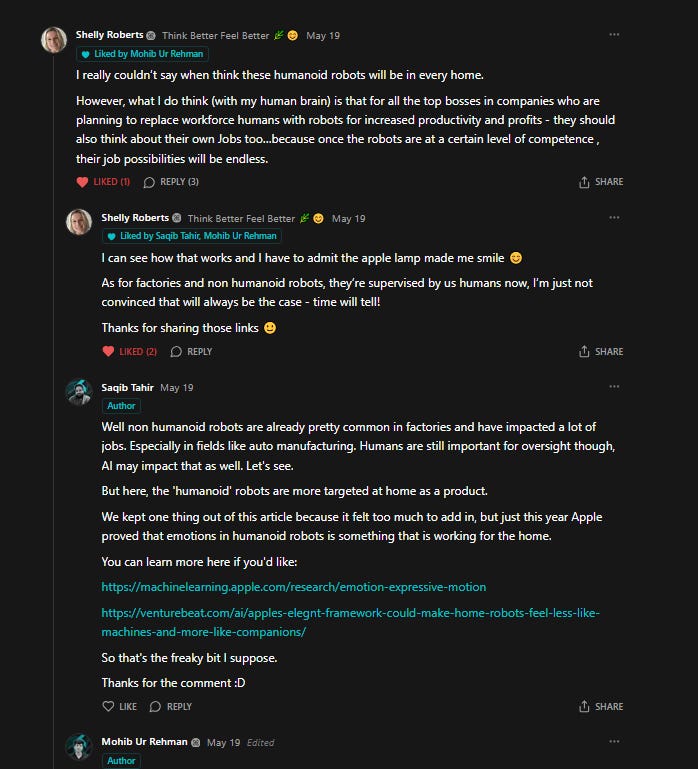
In response to our Humanoid Robot post, Shelly Roberts shared her opinion regarding the humanoid robot industry.
On the Death Of Ownership article, we had Gayle Frances Larkin & Kasia Wilczek sharing their detailed thoughts and stories regarding the subscription model that is deeply rooted in today’s society and how we basically own nothing in the modern world.

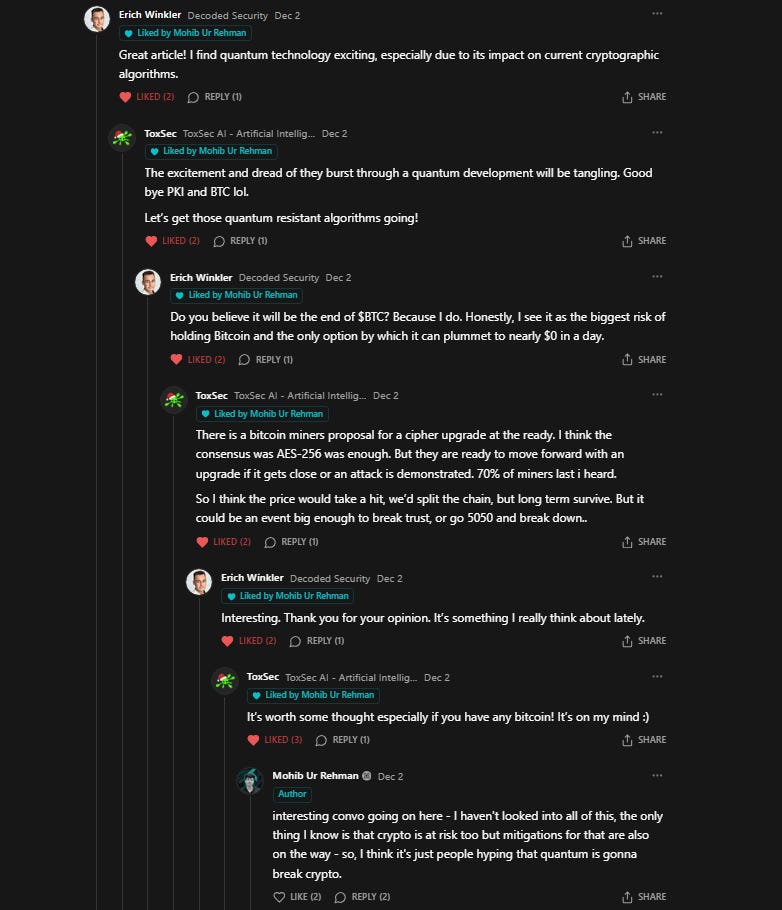
On the Quantum Tech article, we had 2 industry experts Erich Winkler and ToxSec whom we both really like. They started a pretty interesting conversation regarding PQC, and as always, we just took a backseat and listened to them.
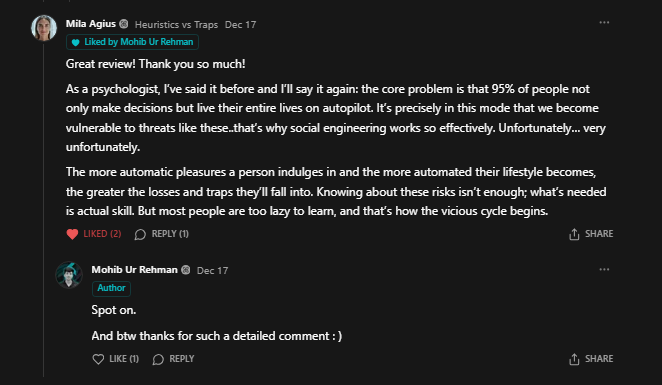
On the Social Engineering post, Mila Agius left such a detailed comment showcasing how dangerous auto-pilot decision making is.
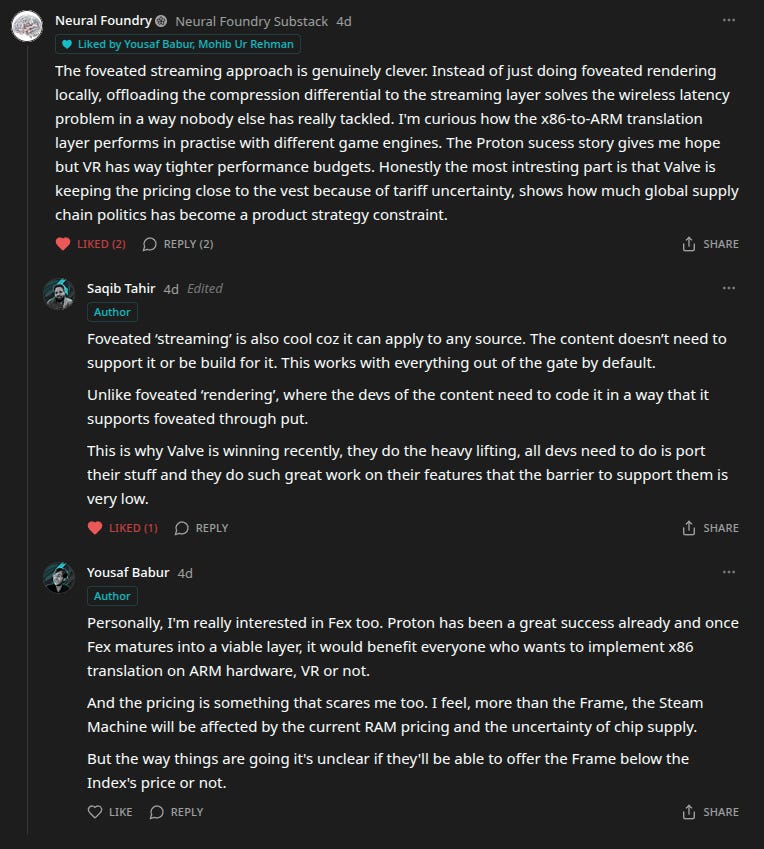
On Valve’s upcoming Steam Frame VR headset article, our reader Neural Foundry shared their interest in the x86-ARM translation layer that Valve is going to implement in the headset. Co-incidentally, that translation layer feature is what we were personally very excited about, and Neural Foundry’s comment further opened up the discussion on the topic.
SK NEXUS also has a squad on Daily.dev where we share our articles and engage with the community.
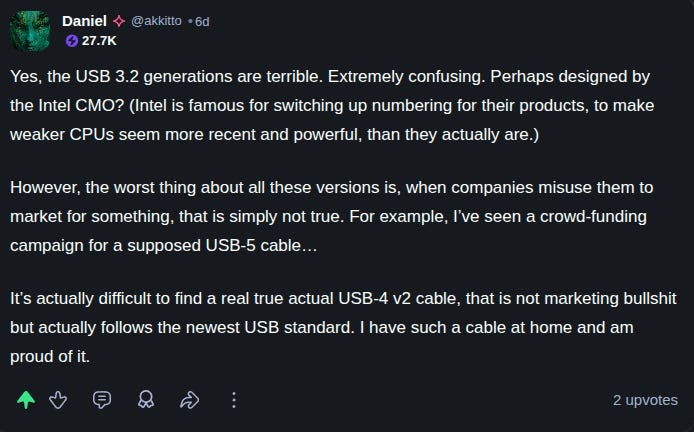
In response to our USB-C article, our reader Daniel shared their frustration with marketing around USB-C and how companies market cables in a really bad way. It was nice to know that we’re not the only ones ranting over the confusion that surrounds the one connector that was created to remove all confusion 😅.
Special Callout: Kernel-Level Anticheats
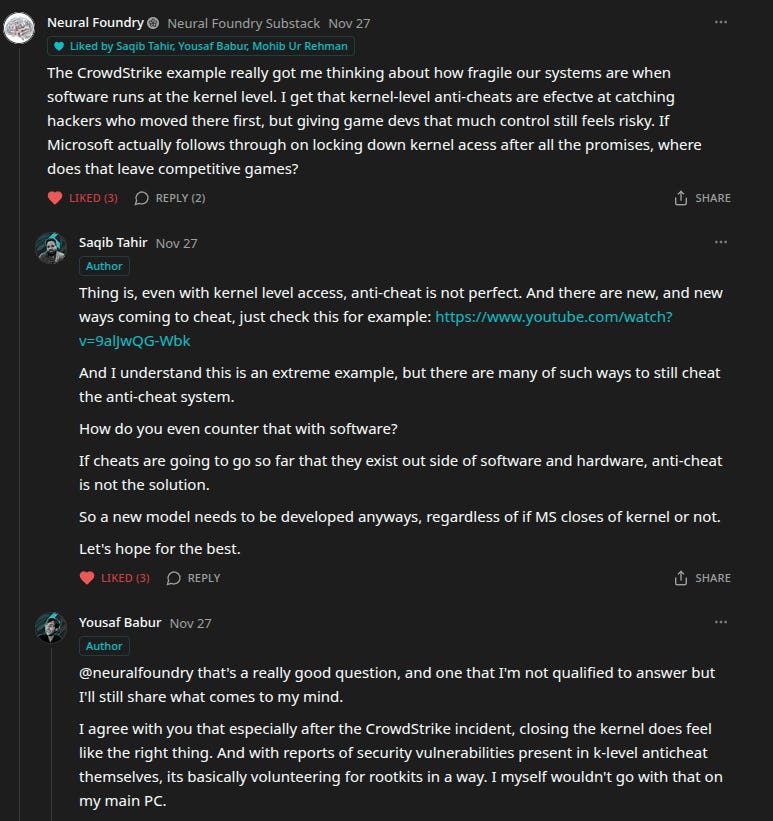
Once again, it was our loyal reader Neural foundry sharing their thoughts on our article on Kernel-level anticheats.
Because of unfettered kernel-level access that much of the anticheat software now has, we saw incidents like the CrowdStrike outage take place last year. It was a reminder to the world that software access should be vetted.
Our reader asked a really good question on the future of anticheat if Microsoft is successful in locking down the Windows kernel. This question got us thinking about the future of anticheats and kernel lockdown on Windows.
Even if we didn’t have the answer they were looking for, we shared some perspective on the possible future, and that is what helps others to reach a conclusion.
Our Takes So Far
What follows next is a series of illuminating insights - a spotlight on some of the most impactful articles we covered in 2025.
It’s been a complex year in many ways, but here’s a glimpse of the content that emerged. We’ll walk you through standout pieces across different categories and highlight a few honorable mentions that can’t be overlooked.
Consider this your guide to understanding what we covered this year.
Consumer Education
Consumer education was our largest content category in 2025, and for good reason. This is where we spent the most time cutting through marketing BS, demystifying jargon, and explaining technology in ways that actually matter to people’s lives.
The goal was simple: help readers make informed decisions about the tech they buy, use, and depend on.
That meant challenging industry narratives about ownership, repairability, privacy, and control. It meant explaining what’s actually happening beneath the marketing language. And it meant providing region-specific context that’s usually missing from Western tech coverage.

Why it was written
Most people still believe that when they buy tech, it’s theirs. The truth is, buying tech today is often more like renting it. With subscriptions, software lock-ins, and even hardware restrictions, what we “own” is actually in the hands of companies who can revoke access at any time.
This conversation is often missing from mainstream tech coverage, and we wanted to bring it to the forefront.
What it tried to answer
We’ve moved into a reality where true ownership, especially in tech, is fading fast. Whether it’s software or hardware, if the companies behind them decide to pull the plug or ban you, you’re left with nothing.
We’re not just renting software anymore, we’re renting our own devices too. The article answered why we’re stuck in this situation and how it’s becoming more entrenched in our daily lives.
Why it mattered in 2025
This topic went mainstream in 2025. Content creators, journalists, and even mainstream outlets started covering the concept of “death of ownership” in tech.
The discussion grew, especially with increasing incidents of hardware locking down. The shift from ownership to leasing or renting is picking up momentum, and this trend will only get stronger in the coming years.

Why it was written
Right to Repair is a good start, but especially for lower-income regions like Pakistan, there are a lot more issues that need solving alongside it. This article was written to bring attention to those gaps.
As someone who loves tinkering with electronics, the Right to Repair movement resonates naturally. But advocacy without regional context misses the point.
What it tried to answer
The intent was to clearly explain what Right to Repair means in common English and how it came to be. Another focus was explaining why it’s not in most companies’ interest to make third-party repairs easier.
Most importantly, the article argued that we need to press companies to ensure availability of repair manuals and parts for third-party repairs; not just symbolic support for Right to Repair legislation.
Why it mattered in 2025
2025 marked the beginning of expensive tech getting even more expensive. People were already tired of paying premiums for their products, and now AI demand is driving consumer prices higher.
It’s high time that more people understand movements like Right to Repair and advocate for reparability and parts availability for the tech they own.

In 2025, privacy reached new lows with the rise of digital IDs, as governments demanded individuals verify their identity on apps under the guise of child protection. Though presented as a safeguard, this trend poses significant privacy risks and paves the way for more countries to follow suit.
The control of personal information by governments is creeping toward dystopian levels, and it’s crucial to question whether the state should be in charge of privacy, parents should take that role, not the government.

This was our first guide for buying used laptops. The topic comes up constantly in our daily conversations, and there aren’t many resources with region-specific advice.
After buying a used laptop in 2024 and going through months of research, dealing with local shopkeepers, and figuring out specifications, we compiled all those learnings into a practical guide.
By 2025, it became clear that many of the things we thought we owned were already slipping out of our hands. Ownership is being replaced with permissions, anonymity with verification, and choice with engineered nudges.
In Europe, GDPR is being quietly weakened while chat control gains momentum, signaling a future where surveillance is normalized and resistance is framed as irresponsibility. Pair that with enshittification, and the direction is hard to ignore.
Because of the non-stop AI hype this year, everyone was already bored of CEOs promising AGI, Full Self-Driving, and features that are perpetually “coming soon.” Our articles tried to cut through that noise and help readers understand what’s real, what’s speculation, and what’s pure marketing.
The underlying message across all our consumer education content: You deserve to understand the technology you’re being sold. You deserve to know what you’re actually buying. And you deserve honest answers about what’s happening to ownership, privacy, and control.
That’s what we tried to deliver in 2025, and it’s what we’ll keep fighting for in 2026.
Industry Highlights
While consumer education helped readers navigate the tech they already use, our industry coverage in 2025 focused on the shifts happening beneath the surface. The infrastructure changes, power dynamics, and platform battles that will shape what tech looks like in the years ahead.
This is where we covered the “why is this happening now?” questions that most tech news skips.
The tech industry went through some surprising turns this year. The biggest was the Linux discussion steaming up among everyday people, something no one saw coming at this scale.

Why it was written
We wrote this article to give a simple perspective on the infrastructure shift happening quietly in front of us and how Linux is no longer just a secret hidden among computer wizards, but a possible reality for a big part of our tech lives moving forward.
What it tried to answer
The first thing we wanted with this article was to clear the word and concept of Linux for someone who has never experienced it, because searching up “Linux” brings up a lot of information that could be confusing for many.
Another goal was to discuss how this change of operating systems is taking place and who the main drivers are pushing Linux discussions to the mainstream. We also discussed who’d be affected by this change.
Why it mattered in 2025
No one had PewDiePie re-appearing as a Linux-nerd on their bingo cards. Valve’s SteamDeck was a success but even Linux users didn’t expect to break 3% desktop market share anytime soon.
Microsoft screwing up Windows was the only thing that wasn’t a big surprise this year :p
But still, the point is that all of this happened in 2025. And with the growing curiosity around Linux there was a lot of confusion, so that’s what made this article necessary.

In a world where technology seems to advance endlessly, not everything is designed for your benefit. Often, it’s a strategy to get you to keep buying.
If people only bought one piece of hardware and never needed anything new, companies would lose money. To keep you coming back, software becomes the invisible force pushing you toward upgrades. Phones slow down, OS updates make older devices obsolete, and new hardware is required for basic functionality; the cycle never ends.
We explored the history of planned obsolescence so that when you make your next purchase, you can recognize the system at play and hopefully make an informed, empowered decision.

Largely because of the SteamDeck, the Linux desktop market share reached an all-time high. Just take that into context: Linux is 34 years old and always hovered around 1-2% before the SteamDeck’s launch. And gaming on Linux was mostly out of the question (at least for a sane person).
The larger point in this article was to focus on SteamOS, its underpinnings (Proton Compatibility Layer), and how that is going to challenge Microsoft Windows’ monopoly, creating a whole new ecosystem for gamers.
Looking back, none of these problems are new; planned obsolescence, Microsoft’s monopoly, forced upgrades, platform lock-in. What changed in 2025 is that alternatives stopped being theoretical.
For 34 years, Linux hovered around 1-2% desktop market share. Gaming on it was a joke. Then Valve’s SteamDeck hit 3%, and suddenly people realized: you don’t have to tolerate Windows anymore. Not because Linux magically improved overnight, but because Microsoft got so bad that the pain of switching became worth it.
If one thing is clear, it’s that we’re going to hear a lot more talk about openness and ownership when it comes to tech, both on the hardware and software side of things.
This year, the EU advocated for far more stringent checks to ensure openness, interoperability, and repairability of tech hardware. And the US president’s front-facing weaponization of access to technology was another grim reminder that dependence on closed platforms is a vulnerability.
2025 shows that more and more governments and companies are looking for ways to own their software and hardware. Whether through hosting on local cloud, self-hosting their operations, or taking the open-source route.
The SteamDeck proved that openness can win on merit, not just ideology. Planned obsolescence articles proved people are tired of being forced into upgrade cycles. Linux adoption proved that when you give people a working alternative, they’ll take it.
If 2025 proved anything, it’s this: people will choose openness when it actually works. Not because it’s morally superior, but because closed platforms treated them so badly that even switching to Linux looked appealing.
That’s a bigger shift than any single percentage point.
While industry coverage tracked macro shifts in platforms and power, our gaming content in 2025 hit closer to home - literally. Gaming isn’t just entertainment; it’s where global pricing models, accessibility barriers, and regional economic realities collide most visibly.
This is where we explored what it actually costs to participate in modern gaming when you’re not in a Western economy, and what people do when the system prices them out.
Gaming
Gaming was among the most interesting categories to write about this year, largely because it forced us to confront uncomfortable truths about access, affordability, and who gets to play.

Why it was written
Growing up in Pakistan made one thing painfully obvious, modern gaming isn’t priced for us. When a $60 game costs half of someone’s monthly income, what can an average person even do at that point?
As a kid, even saving months of pocket money wouldn’t get you there. We saw friends get scammed on shady third-party sites, and we’ve personally jumped regions and bent Steam’s rules just to afford games. That raised a bigger question ”why is all this even necessary?”
This article was an attempt to dig into answering that question, explaining why piracy persists and what forces people into it in the first place.
What it tried to answer
If platforms keep pricing games for Western economies while ignoring regional realities, piracy isn’t going anywhere. Without fair regional pricing and local economic context, people will keep finding workarounds.
And there’s another side of this problem - risk. You don’t know who cracked that game, or whether it’s quietly logging your data or abusing your hardware. Most players aren’t technical enough to spot that. The takeaway was simple: it’s a systemic failure that creates bad outcomes on all sides.
Why it mattered in 2025
Piracy didn’t suddenly appear in 2025, but this was the year our patience ran out. Prices kept climbing, regional realities kept being ignored, and enforcement kept tightening, without addressing root causes.
We wanted to raise our voice and, more importantly, make people aware that this conversation isn’t just about games. It’s about what happens when one side refuses to listen and only enforces rules. The other side adapts, finds loopholes, and moves anyway. That pattern shows up everywhere in tech, privacy, platforms, personal life.
Gaming just happens to be the clearest mirror.

Why it was written
We were really excited to write this article because it involved personal experience. The article was written right after buying a used workstation computer, and the few months of research that went into it produced some surprising results.
We personally went through the process of researching, figuring out specifications, and dealing with local shopkeepers. That’s what made this article special.
What it tried to answer
The intent was to share the experience of buying a used workstation computer. We didn’t even realize that we could get this much compute for roughly $150.
The point was to show that being on a budget doesn’t mean you’re always at a disadvantage. We wanted to demonstrate that if you play it smartly, you can score a good deal without many compromises.
Why it mattered in 2025
It mattered now more than ever as hardware prices skyrocketed because of a number of factors like AI datacenter demand, tariff uncertainty, and global supply chain issues.
Now is probably among the worst times to build a brand-new PC, especially in capital-stressed countries like Pakistan which are struggling financially. That’s why this perspective of buying used was more relevant than ever.

2025 showed how far indie games have come, with small teams competing directly against massive studios something once impossible. As AI-driven layoffs dominated industry headlines, indie developers quietly filled the gaps left by traditional AAA workflows.
We explored how lean teams and fewer layers of bureaucracy are producing better games, while endless AAA delays turned into running jokes.

This article on kernel-level anticheats addressed serious concerns. We’ve seen what happens when software gets unrestricted access to critical areas of your computer with the CrowdStrike incident.
With more and more games implementing their own kernel-level anticheats and Microsoft promising to lock the kernel down, we had to talk about the future of PC gaming as a whole.
Another reason for writing on this topic was because a lot of people were actually concerned about what kernel-level access means. Most of them didn’t understand what ‘the kernel’ even is. We tried to explain it in a simplified manner exactly for those people.

This article on Gaming PC vs Consoles was our answer to this everlasting debate on choosing between a console and a PC with some local perspective that’s largely missing in Western discussion circles.
As someone who has been a console user and now uses PC, we felt we could present a balanced answer to this debate.
Looking back, gaming in 2025 was a study in contradictions. Indie developers proved that small teams can out-innovate bloated AAA pipelines, yet they’re now being punished for using the same tools the rest of the creative world quietly relies on.
On one side, we had an indie uprising with games competing at levels once impossible for small teams. On the other hand, PC gamers specifically are going through tough times as AI eats up our RAM and companies cut off consumer product divisions completely. We saw Micron’s exit and now NVIDIA’s cutting their consumer manufacturing too. It’s just sad.
If one thing became clear in 2025, it’s that the gaming industry’s center of gravity is shifting away from AAA bloat, away from Western-only pricing models, away from gatekeeping around tools and platforms.
Indie developers are filling gaps that billion-dollar studios can’t. Players in non-Western markets are finding workarounds when regional pricing fails. Gamers are choosing kernel-level security over invasive anticheats. People are buying used hardware because new is unaffordable.
The future of gaming isn’t clear, no one is Doctor Strange, but one thing is obvious: if the industry keeps ignoring regional realities, over-policing tools, and protecting outdated models, the center of gravity will keep shifting toward indies, toward workarounds, toward players and creators who refuse to play by rules that were never built for them in the first place.
Gaming in 2025 proved that when the system doesn’t work for you, you build around it.
If gaming showed us where global systems break down at the consumer level, emerging tech coverage revealed where hype and reality diverge most dramatically.
This is where we spent the year asking: What’s real? What’s speculation? What’s pure marketing? And more importantly - what should you actually care about today, versus what companies want you to believe about tomorrow?
Emerging Tech
Emerging tech is where fascination meets skepticism. It’s easy to get swept up in breakthrough announcements and billion-dollar valuations. Our job was to cut through that and explain what’s actually happening beneath the headlines.

Why it was written
We decided to write this article after coming across a quantum tech-related job while searching for work. We were given an assignment to research the topic and write about it. What started as a task quickly became something we enjoyed, even though we still felt a bit out of our depth.
What frustrated us was that most articles on quantum tech sounded like PhD theses. There was a huge gap between the complexity of the topic and what the average reader could digest. We wanted to bridge that gap, starting from scratch to make it simple enough for anyone to understand, while still capturing the essence of this growing field.
Quantum is still far from mainstream, but it’s developing fast, and we felt the need to share that journey.
What it tried to answer
The biggest takeaway is that while we’re moving fast in quantum tech, there’s still a long and challenging road ahead. The hype, especially surrounding post-quantum security, is enormous but maybe it’s necessary to create urgency so companies can begin the long process of building security systems that can withstand quantum threats.
However, we’ve learned that the media loves to sell revolutions before they even exist. Quantum tech is no exception, and though it’s a hot topic, we mustn’t fall for the hype. As someone who works daily around quantum news, our advice is: keep an eye on it, but don’t get swept away by the noise.
Why it mattered in 2025
This article aimed to shed light on quantum tech and its implications for the future. In 2025, people still view quantum computing as something that feels too far from reality. We wanted to demystify it and show what’s actually happening today in quantum research and security.
By explaining the complexities in simple terms, we wanted to help readers understand what’s real, so when quantum tech is discussed, it won’t sound like some Star Wars movie.

Why it was written
The motivation behind this piece was personal interest in the topic. We’ve been following the technical side of self-driving for some time now from the perspective of a fascinated observer.
One day, we were just discussing self-driving cars with Saqib while hanging out in The Wandering Pro Discord server (which you should definitely check out!). That casual discussion was the spark to write on self-driving cars.
What it tried to answer
The intent was to give a realistic account of the self-driving space as it stands today and how it continues to evolve.
The first article in the self-driving series gave context by providing a comprehensive overview of the self-driving scene, including the big players involved like Tesla, Waymo, etc.
Another major aspect was discussing the LiDAR vs Computer Vision debate that exists in the self-driving space which players are betting on what technology, along with the pros and cons for both.

The last article in this series discussed two of the biggest exits in the self-driving space. A large portion of that article covered the secret car project that Apple worked on for close to a decade.

Why it mattered in 2025
The self-driving space is among the most talked-about domains when it comes to Applied Artificial Intelligence. In 2025, we’ve already started seeing public roll-outs of self-driving cars in fancy cities around the world.
It was necessary to distinguish the real ‘self-driving’ from what companies have been promising for years and discuss the current technology and how it could evolve in the future.

2025 was a pivotal year for the humanoid robot industry, with sightings of robots like NEO, the so-called “next-gen” model - becoming mainstream. Everywhere you looked, discussions about humanoid robots taking over our jobs and lives were taking place.
The hype surrounding this technology was massive, with people both fascinated and fearful about the implications of robots that resemble us so closely. Given the buzz, we felt it was necessary to dive into the reality of this topic. We explored why everyone is investing in it, while addressing the potential and challenges that come with this futuristic technology.

As 2025 was coming to a close, Valve gave us a chance to discuss the cool technology powering their upcoming Virtual Reality headset - The Steam Frame.
The point of the article was to discuss how the gaming VR ecosystem is going to establish itself after Meta has gone past overspending on VR and Valve has come back, 6 years after their first headset.
Even though we didn’t have much information on pricing, the cool technology like run-time translation of PC games, 6 GHz wireless streaming, and Foveated Streaming built into the headset was just too much not to discuss. That’s what we did in the article 😁.
Looking back, emerging tech in 2025 was a masterclass in hype outpacing reality.
We’re drowning in shiny tech narratives. AI, humanoid robots, quantum, self-driving- every week there’s a new breakthrough announcement. Hype moves faster than reality, and most people can’t tell the difference.
And this is the real risk; not the tech itself, but how easily we buy into headlines without understanding what’s actually happening underneath.
In the emerging tech space, Artificial Intelligence dominated mindshare all year. Even though the hype slowed a bit (relative to the previous year), the momentum hasn’t. Companies are still reaching 5 trillion dollar market caps on promises, not delivered products.
On the hardware side, we have companies like Valve working on genuinely cool technology, but affordability is becoming a serious concern, especially when AI is eating our RAM and driving up hardware costs across the board. God knows what 2026 holds for tech hardware pricing.
Whether it’s quantum computing, humanoid robots, self-driving cars, or AI; just know that these systems are built by humans, limited by physics, economics, and messy real-world constraints.
The media loves to sell revolutions before they exist. Companies love to promise capabilities years before they can deliver. And investors love to fund narratives that sound like science fiction.
But breakthrough announcements don’t mean breakthroughs happened. Public roll-outs in “fancy cities” don’t mean the technology works everywhere. Billion-dollar valuations don’t mean the product is real.
Going forward, keep one thing in mind: when a new technology shows up, don’t chase the shine. Study the mechanism. Understand what it can do today, not what it’s promised to do in ten years. Form your own judgment before someone sells you theirs.
That’s the only way to stay grounded when everyone around you is buying lottery tickets and calling them investments.
Our Moat: Deep Dives
Most tech publications follow a script: react to news, summarize press releases, amplify what’s trending. Speed and volume win.
We don’t do that.
Not because we’re above it; fast, relevant takes have value but because that’s not our competitive advantage.
We can’t outpace professional newsrooms or beat algorithmic content farms at scale.
What we can do is go deeper.
What Makes a SK NEXUS Deep Dive
A deep dive isn’t just a long article. It’s a deliberate choice to prioritize understanding over immediacy.
Our deep dives share a few traits:
They explain systems, not just events. Instead of “NVIDIA hits $5 trillion market cap,” we ask: How did a gaming chip company become the backbone of AI? What decisions got them here? What does this mean for the future of computing?
They challenge hype. Every hot tech trend comes with exaggerated promises. Our job is to cut through the noise and explain what’s real, what’s speculation, and what’s marketing.
They’re accessible without being shallow. We assume curiosity, not expertise. We define terms, use local examples, and build up complexity gradually.
They connect global trends to local realities. Understanding why TSMC matters isn’t complete without discussing what a chip shortage means for Pakistani consumers trying to buy electronics.
Why Deep Dives Are Rare
Most publications can’t afford them. Deep research takes time, reading company histories, understanding technical architectures, tracing supply chains, rewriting for clarity. That’s days or weeks per article, not hours.
We can do it because we’re small. No editorial committees, no advertiser expectations, no pressure to publish five times a day. We optimize for quality, not quantity.
The trade-off: we publish less. But what we publish lasts. Our articles from early 2025 still get traffic because they explain fundamentals, not fleeting news.
We keep doing these because it’s the work worth doing.
In a media landscape optimized for clicks and virality, depth is counter-cultural. But it’s also where trust gets built. Readers remember the publication that actually explained something, not the one that fed them a headline.
And frankly, we enjoy it. There’s a satisfaction in researching a complex topic, understanding it fully, and then making it simple for others. That’s the craft we care about.
Featured Deep Dives from 2025
Here are three pieces that embody this approach:

Why it mattered: While most tech companies chase quarterly earnings and scale at any cost, Valve quietly built a $10+ billion empire on a completely different model: flat hierarchy, no managers, employees choosing their own projects. In 2025, as layoffs dominated tech headlines, Valve’s alternative approach felt more relevant than ever.
Key insight: Valve’s “weird” company structure isn’t just ideological - it’s strategic. By avoiding external capital, maintaining employee ownership, and optimizing for long-term R&D over short-term ROI, Valve can take massive bets (like the SteamDeck and Proton compatibility layer) that publicly-traded companies can’t justify. The result: they’ve built an open-source gaming ecosystem that’s challenging Microsoft’s monopoly without needing venture backing.

Why it mattered: In 2025, NVIDIA became the first company in history to hit a $5 trillion market cap. Everyone knows they make AI chips. Almost no one knows how a gaming graphics card company became the most important infrastructure provider of the AI era or why competitors can’t catch up.
Key insight: NVIDIA’s dominance isn’t just about better chips; it’s about the CUDA ecosystem they’ve been building since 2006. By investing over a billion dollars into GPU programming infrastructure long before AI went mainstream, NVIDIA created a moat that’s nearly impossible to replicate. When AlexNet proved in 2012 that GPUs could accelerate AI, NVIDIA was the only company ready. Competitors are still playing catch-up to decisions made 15+ years ago.

Why it mattered: TSMC manufactures over 90% of the world’s most advanced chips. If TSMC stopped production tomorrow, the global economy would collapse; not in metaphor, but in fact. Yet most people have never heard of them. In 2025, as US-China tensions escalated and chip shortages became geopolitical weapons, understanding TSMC became essential.
Key insight: TSMC’s dominance comes from a business model decision made 40 years ago: be a “pure-play foundry” that only manufactures chips, never designs or sells them. This meant companies like Apple, NVIDIA, and AMD could outsource production without worrying about competition. The result: TSMC became the sole supplier of cutting-edge chips for the entire tech industry. Their success is Taiwan’s “Silicon Shield” - the reason global superpowers care deeply about a small island nation.
Why This Matters
Deep dives are our moat because they’re defensible.
Anyone can summarize a press release. Not everyone can explain complex systems clearly, challenge industry narratives honestly, and do it with local context.
That’s the work that compounds. That’s the work that builds trust. That’s the work we’ll keep doing in 2026.
That being said, let’s hear from the writers hard at work -
Mohib Ur Rehman
Before SK NEXUS, writing wasn’t a plan. I was gaming to make a few bucks, messing around with security concepts, learning things the messy way, and occasionally dropping a blog post into the void. Then I stumbled into SK NEXUS and decided to give it a shot. I didn’t expect much. Turns out, I got tricked into a career.
Everything I learned here - researching properly, questioning assumptions, simplifying complex systems, and defending ideas with logic - quietly stacked up. Enough to land a job, enough to change how I think. That still feels unreal.
Early on, I looked up to Yousaf Babur and his writing. He already had a rhythm and a lane. Over time, I realized that his domain wasn’t mine and that was a good thing. Writing here forced me to find my own lane - privacy, control, gaming economics, AI, etc.
Most importantly I honed the art of learning by execution, failing in public, refining my voice piece by piece - that process was uncomfortable and addictive in the best way.
I grew the most when I dealt with the hardest stories - the ones that didn’t have clear answers and made me uncomfortable. Topics where I didn’t know enough, where I had to admit ignorance first and then earn clarity. That taught me the most valuable skill I picked up this year: not knowing isn’t weakness - refusing to figure it out is.
Looking ahead, I want to go deeper. More complex topics, more uncomfortable questions, more building my own positions - whether it’s AI, gaming, privacy, or whatever chaos comes next.
I’m still at the start. 2026 is wide open.
And if you actually read this far - congrats. You’ve earned knight status. 🗡️
Yousaf Babur
It feels unreal to say that 2025 has passed. Honestly, it feels like yesterday when we just wrapped the second season of the Tech Made Fun podcast.
2025 has passed and while ASI hasn’t destroyed humans yet, we’ve seen AI (specifically LLMs like GPT, Gemini) get really good. For long I resisted their use in my workflow until they started delivering results.
Being a Linux user, it feels good to see that people are actually talking about open-source software and interested in challenging monopolies like Microsoft who year-and-year again have shown nothing but complacency.
I am a bit sad about the politicization of technology around us, especially software but what can I even do about it?
The RAM situation that is just emerging does scare me as it has a far-reaching impact on every device using a computer. And it feels like it will only increase next year.
Still, cool tech is what interests me. I’m really looking forward to Valve releasing their next-gen hardware. Let’s hope they don’t shelve it like the earlier version of Half-Life 3 lol.
I’m really interested in the impact that Valve brings through SteamOS and their upcoming hardware. On Linux, I can already play my steam library just through the Steam client. This is something that wasn’t remotely as easy 5 years ago.
Whatever the situation is, you people can count on me to cover exciting tech and simplify it for you guys with a local perspective on things going forward.
The process of researching for articles has compounded my tech knowledge this year. I wasn’t completely sure of HDR. I didn’t know of Steam, TSMC or NVIDIA’s origins.
But because I went through the research and writing part for articles on SK NEXUS, I have a lot more information to share and topics to discuss.
I cringe when I go through some of the oldest articles I wrote at SK NEXUS, but also feel good that I’ve improved a lot. I can see the improvement in research, writing, and presentation.
As a writer, this year was special because I’m not just a writer anymore. I am now more involved with my readers (thanks to our migration to Substack). I’m pretty active on SK NEXUS’ squad at Daily.dev.
Going forward, you can expect a lot more content from me that is not just researched better but written in a much clearer way. You will see a lot more activity from me here on Substack outside of just sharing articles.
Signing off from 2025 - Yousaf
We started this review by saying SK NEXUS is still small. That’s true.
But small doesn’t mean insignificant.
In 2025, thousands of people read our work. Hundreds left thoughtful comments. Dozens shared articles with friends, colleagues, and communities. Some of you cited our pieces in your own work. A few of you told us SK NEXUS changed how you think about tech.
That matters.
Not because we’re special, but because you made space for this work to exist. Every read, share, and comment validated that there’s an appetite for tech writing that’s clear, honest, and contextually grounded.
You didn’t just tolerate SK NEXUS - you actively engaged with it. You challenged our assumptions. You corrected our mistakes. You contributed your own perspectives. That’s what turned this from a blog into a publication.
So, thank you.
If you’ve been reading since the early days: thank you for sticking around.
If you joined us mid-year: thank you for taking a chance.
If you’re discovering us through this review: welcome. We’re glad you’re here.
What Happens Next
2026 will bring more of what worked in 2025: deep research, honest writing, and a relentless focus on explaining tech clearly without dumbing it down.
It will also bring experiments; some will land, some won’t. We’ll learn either way.
The only way this works is if you keep showing up: reading, responding, sharing, questioning. Independent media survives on reader trust, not algorithms or ad revenue. Your attention and engagement are what make SK NEXUS sustainable.
One Last Thing
If there’s a topic you think we should cover, a question you want answered, or a critique you’ve been holding back - tell us.
Use the comments. Email us. DM us. We read everything, and we take feedback seriously.
This publication exists because of you. Let’s make 2026 even better.
Here’s to another year of learning, questioning, and making sense of the tech shaping our lives.
With or without my help – I wish you the best.
- Saqib Tahir
Founder & Editor, SK NEXUS
Great read! I really appreciate how SK NEXUS focuses on real engagement and purpose rather than chasing flashy numbers. The honest reflection on growth and learning truly stood out.
Looking forward to seeing how this journey continues in the year ahead.
And thanks for the knight status🗡️
Congrats on the milestone 👏
This piece really captures what real growth looks like, not metrics, but readers who think, push back, and stay.
Also appreciate the shoutout in the quantum discussion. Those kinds of thoughtful back-and-forths are exactly why I like Substack over other platforms.
Wishing you a strong 2026! And I am excited to see where you take SK NEXUS next.