



Hey there 👋
Some time ago, I covered prediction markets, what they are, how they work, and why they’ve suddenly become part of mainstream conversation.
At the time, I thought that was enough. Another weird internet-native financial product sitting somewhere between gambling and politics. But then I ended up watching one of Nilay Patel’s podcast discussions around prediction markets, and it pushed me back into the rabbit hole again.
And to me, this whole thing feels strangely familiar.
Think about where we were around ten years ago. Sports betting ads were controversial. Gambling companies weren’t deeply embedded into mainstream entertainment yet. Today, betting platforms sponsor broadcasts, creators openly promote gambling apps, and odds are treated like part of the viewing experience itself.
Now look at prediction markets.
We’ve reached a point where market odds are being cited as news before the event itself has even happened. A politician makes a statement, odds move instantly, and suddenly the movement becomes part of the story.
And that’s really the purpose of this piece, to look at what happens when speculation starts becoming the lens through which people process reality itself.
The Pseudo-Event Problem
Traditionally, news had a fairly simple foundation - something happened, reporters verified it, evidence emerged, and coverage followed. The sequence mattered because journalism was tied to documenting events that had already occurred.
But modern media ecosystems introduced another category entirely - Pseudo-events.
These are events designed primarily to generate attention and coverage rather than communicate something meaningful. Press conferences teasing announcements, staged debates, “major updates coming soon,” carefully timed leaks…etc.
So what’s the real purpose of these pseudo-events? It’s to create anticipation & engagement around the possibility of something happening.
Prediction markets fit perfectly into this environment because they thrive on uncertainty and the markets just need people to guess on whether it might happen or not.
You can already see how the cycle forms.
A political campaign announces that a “major policy change” is coming next week. Prediction market odds react immediately. News outlets begin reporting that movement as if it reflects meaningful new information. Social media discussions explode around the odds change itself.
Then the announcement gets delayed or watered down, but by that point, it doesn’t really matter because what’s done is done.
And that changes the role of journalism in subtle ways.
Instead of reporting on verified developments, coverage begins orbiting around speculative momentum. The narrative becomes the event. Odds movement becomes the update and overall, the market sentiment becomes something reporters feel pressured to include because everyone else is watching it too.
How Prediction Markets are Reframing Themselves as Truth Infrastructure
The language around prediction markets has changed a lot over the last few years.
Instead of “gambling,” the industry talks about “forecasting,” “market signals,” and “information aggregation.”
Polymarket itself describes itself as a system that uses markets to make sense of real-world events. Kalshi uses the language of “event contracts” and regulated forecasting markets, emphasizing legality and data rather than speculation.
And quite frankly, the reframing works because if you’re a news outlet trying to support a story with numbers, prediction markets will do the job, just fine because the odds look pretty similar to polling data. On top of that, both move over time and both appear to reflect public expectations.
But they measure completely different things.
Polls measure what people say they believe. Prediction markets measure where money is flowing based on what participants think might happen and this distinction matters a lot more than people realize.
During the 2024 U.S. presidential election cycle, prediction market odds started appearing in mainstream political coverage alongside traditional polling. Headlines discussing changes in Polymarket odds were presented almost like electoral indicators, which these markets are not.
And this creates a loop very pretty quickly - A market moves. News outlets cover the movement. Readers see that coverage and assume something important changed. More people enter the market, the odds update again, and another round of coverage follows.
Before you notice, the conversation revolves around market activity itself.
This is also where pseudo-events fit naturally into the system. A campaign hinting at a “major announcement,” can move odds within minutes, even if nothing concrete actually exists behind it.
The coverage still happens and it becomes clear that the whole world is reacting to narratives moving through the media cycle. And when those reactions start getting treated as cues for something important, it becomes really hard to separate actual reporting from speculations.
Digital Déjà Vu
A lot of this feels familiar because we’ve already seen a very similar transition happen with sports betting.
The language around sports betting slowly evolved over time.
Betting platforms stopped presenting themselves purely as gambling products and started positioning themselves as part of the viewing experience. Odds became live analytics. Gambling became fan engagement and real-time betting became interactive sports entertainment.
Today it’s difficult to watch major sports broadcasts without betting odds appearing directly on-screen. These companies sponsor teams, creators, podcasts, and even entire segments during live coverage. The integration became so normalized that for younger audiences, it barely even registers as gambling anymore.
Now look at how prediction markets are being framed.
The same vocabulary transition is happening again and the underlying behavior hasn’t changed much. People are still putting money behind uncertain outcomes.
Prediction markets operate much closer to real-world events. Elections, regulations, wars, economic policy, company decisions - all of it becomes something users can financially bet on.
That changes how these systems interact with public perception. These markets are in real-time influencing how people process information itself due to which a market movement is soon going to look like some kind of signal about reality.
And that creates a very different kind of environment compared to traditional gambling platforms.
The Gacha Parallel
This pattern also resembles what happened with Gacha systems and loot boxes in gaming.
For years, games introduced mechanics built around randomized rewards, especially in mobile titles. Players spent money for a chance at obtaining specific characters or items, often through systems designed around probability and repetition.
A large part of the audience exposed to these systems was underage.
Regulatory responses came slowly, and by the time serious discussions started happening around loot boxes and gambling mechanics, millions of players had already grown up with these systems as a normal part of digital entertainment.
I covered this in much more detail in my gambling article, so I won’t go too deep into it again here.
But prediction markets follow a surprisingly similar structure.
Betting on things has been gamified. Platforms encourage users to track outcomes, compare positions, share predictions, and continuously engage with unfolding events. And unlike Gacha systems, prediction markets aren’t confined to gaming communities because these markets target anyone consuming information.
That’s the scale difference - sports betting monetizes attention around sports. Gacha systems monetize progression and reward loops inside games. Prediction markets monetize uncertainty surrounding real-world events themselves.
The Future of Market-Driven Information
The bigger concern here is that - what happens when prediction markets become embedded into everything else.
We’re already seeing the early stages of it. Prediction market widgets appear inside social feeds. Creators reference market odds during discussions. News outlets cite betting probabilities alongside reporting.
Furthermore, political campaigns are beginning to optimize for market reactions. Headlines are written around odds movement because it generates engagement. Financial incentives are starting to shape public discourse at an individual scale.
For younger audiences growing up inside these systems, checking the odds is going to become more of a common reflex than verifying the source.
And this ties directly into the ecosystem discussion we had earlier.
Prediction markets are following the same pattern most modern platforms follow. First comes integration, after that normalization & dependency follow. And the more deeply odds become embedded into feeds and conversations, the harder it will become to separate speculation from the way people interpret events altogether.
Why This is Worse Than You Think
Fake News Becomes Profitable at Individual Scale
Right now, misinformation mostly runs on attention. People spread false or misleading content because it generates clicks & engagement.
Prediction markets introduce another layer on top of that which adds a direct financial incentive attached to shaping public sentiment itself.
In November 2025, a staffer at the Institute for the Study of War made an unauthorized edit to one of the organization’s maps showing Russian forces capturing a key intersection in the Ukrainian town of Myrnohrad. That was a big move because Polymarket relied on those maps to settle war-related contracts.
Because of that, users who had bet on Russia taking the city reportedly made returns as high as 33,000%, with the total market reaching around $1.3 million. Later, the edit disappeared. The Institute for the Study of War (ISW) stated that the change had not been approved and removed it from the next day’s workflow. Shortly after, one of the organization’s geospatial researchers disappeared from the website and reports indicated the staffer had been fired.
The important part here is the realization that if somebody can manipulate information connected to a market, it becomes possible to financially benefit from influencing real-world situations tied to those bets.
Markets Can Be Gamed by Coordinated Actors
Another issue is how easily markets can create artificial signals.
A small but coordinated group placing concentrated bets can move odds significantly, especially in thinner markets. Once those odds move, social media notices. News coverage follows. People outside the market start interpreting the movement as meaningful information.
And the cycle feeds itself from there.
We already saw a version of this during the Maduro case covered in Part 1.
In early 2026, a Polymarket account placed large bets predicting Venezuelan leader Nicolás Maduro would lose power before the end of the month. The timing immediately raised eyebrows because the trades were placed only hours before a surprise U.S. military operation ultimately removed him from office.
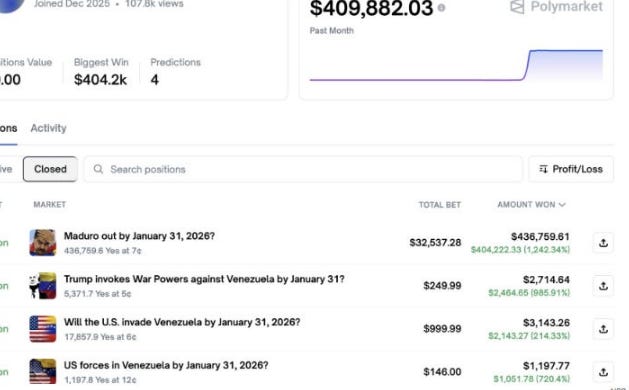
When the outcome was confirmed, the account reportedly walked away with close to $400,000 in profit.
What made the situation stranger was the account itself.
It had very little trading history and appeared to exist almost entirely around those specific wagers. Naturally, people started asking whether the trader simply got extremely lucky or whether the bets reflected access to information the public didn’t have.
And even if no direct wrongdoing occurred, the bigger issue remains the same.
Prediction markets create environments where market activity itself starts behaving like a signal. A sudden odds movement can influence public perception long before anyone knows whether the underlying information is reliable which can create a system where coordinated actors just need enough momentum to make people believe something important is happening.
What You Should Keep In Mind
Understanding What You’re Looking At
The first thing to understand is that prediction market odds are not truth indicators. They just reflect where money is moving. So when you see headlines citing market odds as evidence of something becoming “more likely,” it’s worth asking a few questions:
Who benefits if public perception changes?
Who is placing the bets?
And what incentives exist behind the movement itself?
Markets can aggregate sentiment, but sentiment and reality are not the same thing.
In short, a percentage attached to an outcome does not automatically make the underlying claim more credible which is why verification still matters
Don’t Let Odds Replace Sources
Prediction markets become much more influential when they get embedded directly into the platforms people already use.
Odds inside social feeds, prediction widgets attached to news coverage, creators casually referencing betting percentages during discussions - all of this gradually conditions audiences to treat markets like informational shortcuts which plays a key role in forming a new habit that involves people depending on odds instead of credible sources.
So what’s the solution?
If platforms give you the option to disable prediction widgets or betting integrations, turn them off. If creators constantly frame discussions around market activity, recognize with your whole heart that you’re being pushed toward interpreting speculation as meaningful information.
Closing Thoughts
Prediction markets are moving through a very similar process to what we have seen in the past with the whole gambling matter.
If these systems become normalized, reversing it would be much more difficult.
And all of this is happening in an internet environment that is already messy enough.
We’re surrounded by AI-generated content, bots, misinformation, deepfakes, algorithmically amplified narratives - distinguishing between reality and manipulation is already getting harder by the day.
Prediction markets add another layer to that environment and the substructure around it is still being built.
That’s why awareness matters now, before these systems become deeply embedded into the way people consume information every day.