
Hey there 👋
Some time ago, Coffeezilla dropped a deep dive into the world of gambling - the kind that exposes the whole system. I watched it casually at first, then I rewatched it and after that…I started diving down.
That’s when I realized how deep this thing actually runs.
What would have been a quick side curiosity turned into days of researching and connecting dots. Every time I thought I’d reached the end, there was another layer underneath. Another system doing exactly what it was designed to do - just quietly.
I didn’t plan to write about this right away. In fact, I kept putting it off because it demanded some real work.
But here I am…because my curiosity won against my laziness.
Let’s get started.
Picture a streamer cracking open a loot box. Lights flash, chat explodes and the dopamine starts spiking. It feels spontaneous and this scene plays out millions of times a day.
But behind all this - sits a carefully tuned reward system, built to keep players spinning, opening and chasing. This is what most people don’t realize – everything right from the first spin was engineered.
This brings us to today’s topic - “Gamblification” - know that, it didn’t arrive overnight. It evolved from Gacha game design, mobile engagement loops and the psychology of slot machines. Today, it’s threaded into modern gaming so tightly that most people don’t even recognize it for what it is.
Read this piece closely and the systems will reveal themselves. You’ll start noticing the same tricks outside gaming too. Banking apps, shopping platforms, influencers. All using the same psychological playbook.
This post will focus on gaming because it exposes the mechanics best, but these patterns stretch across your entire digital life.
Where the Pattern Was Born
To understand how gamblification spread into everything around you, we need to rewind to the starting point. Before the loot boxes took over the West and before every app learned these tricks, there was one ecosystem that perfected the formula.
Gacha games.
This is where the framework took shape. Once you see how it began here, everything else that came after it will automatically start to make sense.
What is a Gacha Game?
A Gacha game is built on a simple mechanic: you spend in-game currency and you get a random reward. Players call it pulling, rolling, or spinning, but the core idea is the same - you trade resources - sometimes earned through gameplay, sometimes bought with real money for a chance at something better. A new character, a rare skin, a powerful item.
And the randomness you see in the Gacha system is controlled probability. Developers behind the scenes are the ones pulling the strings. They are the ones who decide the drop rates, the rarity tiers, the banners…etc. You never fully know what you’ll get, but the system always knows exactly how often players are allowed to hit the jackpot.
The entire experience is designed to make the process feel harmless while quietly nudging you toward one more pull and the whole mix of uncertainty and structure is what keeps people rolling.
Why is it Called Gacha?
To understand the name, you need to go back to Japan. The word “Gacha” comes from Gachapon. This word stands for toy vending machine capsules.
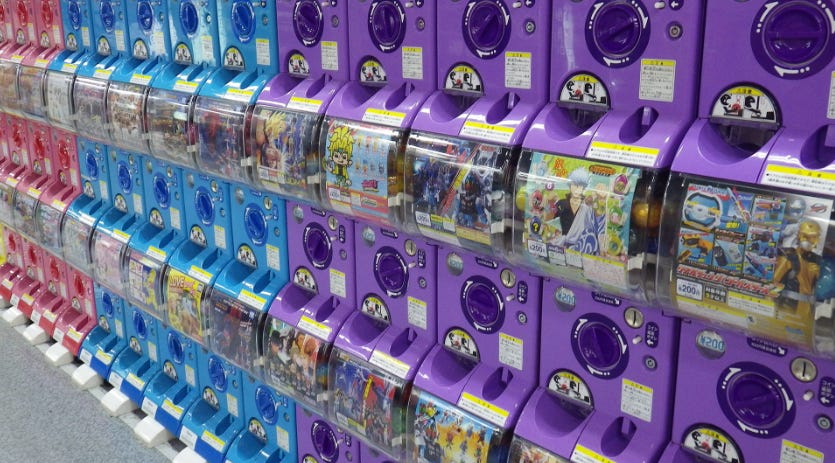
Okay, but what do vending machines have to do with mobile gaming?
The randomness factor.
You put in a coin, twist the handle, and out comes a sealed capsule with a mystery toy inside. High chance of something common & a tiny chance of something rare.
That’s the blueprint - Mobile games took this exact system and digitized it. Instead of plastic toys, you get characters, costumes or currency. Instead of coins, you spend gems, tickets, or whatever in-game currency the economy revolves around.
Well…what’s the outcome?
It’s a feeling - a rush right before the capsule drops, hoping this time you might end up getting something special.
How Does Gacha Work?
The entire system runs on drop rates - fixed odds that decide what you get every time you pull.
Everyone’s favorite ultra-rare characters sit at the bottom of the probability chart, often below one percent and the only way to get them is through the Gacha itself. There’s simply no alternative.
So, if Jimmy wants the coolest skins, then he will have to roll until the game finally hands that to him.
Did you notice the pattern?
All the rare items are locked behind this single mechanic and unlocking it requires rolling for a very long time - This keeps the player hooked to endlessly pulling the lever and ultimately this mechanism makes them addicted to the game.
And pulling isn’t free either - if you want to pull more often, you’ll have to buy more currency and this does the perfect job of putting holes in the player’s wallet.
Another interesting thing is - almost every Gacha-driven title is free-to-play & people think they can progress without paying. In reality, the deeper you go, the more the system tightens. If you want to stay competitive or avoid looking like a starter player forever, the game slowly pushes you toward spending.
Gacha System vs Loot Boxes
People love to mix up Gacha and loot boxes together.
At surface level, sure - both hand out randomized rewards, usually tied to items, skins, or currency.
Both systems need fuel - either in-game currency or real money - yet their role inside the game is pretty different.
Gacha is the core economy.
It’s the primary way players unlock what they actually need to progress. This can include - characters, upgrades, power boosts - in a way, Gacha is the beating heart of the game’s monetization loop.
That’s why games using this system get their own label: Gacha Games.
But loot boxes? They are merely a side hustle.
A loot box is just a bonus mechanic sitting on top of the main progression. Whatever’s inside can usually be earned somewhere else - often slower, but still doable.
In short, loot boxes just complement the game, they don’t define it.
So the relationship works like this:
Gacha → always central
Loot box → optional
And here’s another important thing to keep in mind:
All Gachas are loot boxes
But, not all loot boxes are Gacha
Why Gacha Breaks Players
Gacha has a reputation problem and it’s earned.
People call it “gambling in disguise” because that’s exactly how it behaves. Same reward loops, same adrenaline spikes & the same crash when the result isn’t what you hoped for.
And the addiction hits everyone.
You’ll find horror stories everywhere. A Fate/Grand Order player spent $70,000 chasing his favorite characters. A YouTuber burned $7,200 on Genshin Impact before publicly denouncing Gacha and behind every viral story are thousands of smaller ones, people who felt baited into paying and regretted it the moment they stopped.
Governments did try to do their part…
Some countries now require public drop rates, while others have straight-up outlawed certain Gacha practices.
But companies are always coming up with new workarounds, so governments can’t really solve this issue.
Anyway - the real trap is that - Gacha games are free to play, but progression without spending is basically impossible. The design keeps pulling you toward new characters, better skins & limited items that always look just slightly out of reach.
Natasha Dow Schüll writes in Addiction by Design that - many gambling addicts don’t play to win, they chase the escape, slipping into what she calls the machine zone. Gacha leans on that same psychological loop.
If you’re curious about how these systems manipulate you, give the book Addiction by Design a read or you can also check out my article on dark patterns:
The Digital Casino We Built Ourselves
You’ve seen how the Gacha system works.
Now zoom out.
That mechanic didn’t stay in Japan. Its success became a blueprint because uncertainty makes money.
Here’s where the modern industry now stands:
Western studios folded the same system into loot boxes, cases, and daily spins and somehow sold it as “innovation”.
Mobile developers pushed it even further, building whole economies around random pulls and character drops.
And underneath it all sits the real engine - psychology tuned for addiction. Reward loops, dopamine spikes, manufactured desire and you’re about to see how each piece holds players in place.
The upcoming sections are going to be an eye-opener. From the rise of mobile Gacha and Valve’s Arms Deal update to the behavioral tricks engineered to keep players hooked - we’re about to peel the whole thing back.
The Blueprint: How Gacha Took Over Mobile Gaming

The Origins - Gacha Was Born on Phones
The digital Gacha craze traces back not to a triple-A console smash but to a modest 2010 mobile card game called Dragon Collection.
The game was launched on the Japanese social-gaming platform GREE, the entire game was built around randomized pulls. You spent virtual (or real) currency, drew dragon-cards of varying rarity - That unpredictability and uniqueness turned into a formula.
Following Dragon Collection’s success, a wave of mobile titles incorporated Gacha mechanics and some exploded.
One early standout was Puzzle & Dragons (launched 2012). In this game - players used premium currency to summon monsters - then built teams to tackle dungeons.
Then in 2015, Fate/Grand Order leveled up the game. It added story, deep characters, constant updates, and basically made everything 10x better.
And here’s the interesting part about the Gacha system: it works almost too well in character-driven games. Role-playing-games (RPGs) offer a natural fit for Gacha because progression is more than about gear or levels, it’s about collecting unique characters through chance, then upgrading them.
That collection + uncertainty + power spike loop acts as a dependable monetization engine.
And once the profits showed up, every major studio took notice. A system that started as a niche Japanese experiment turned into a global standard, powered by randomness, addiction, and an endless stream of content updates.
Asian Markets: Where Gacha Became a Machine
If you want to see Gacha at its peak, look East.
In Japan, nearly all of the top 200 grossing games include some form of Gacha - a level of adoption you won’t see anywhere else in the world. The system started here, and it still thrives the most here.
Zoom out to the wider Asian mobile game market and that’s when you will notice something even bigger.
Asia dominates global revenue charts. In 2022, three of the top five countries by mobile game revenue were Asian:
China: $42B, 744M players
Japan: $13B, 77M players
South Korea: $5.2B, 34M players
Together, they form the bulk of the $110B global mobile gaming market. And even with a slight slowdown from 2021, Asia’s growth still outpaces most other regions.
This is exactly why Gacha took off here. The scale, the spending habits, the “pay small, pay often” culture - everything aligned.

When the West Realized Gacha Was a Cheat Code
Once Asia started printing billions, the rest of the world paid attention.
Studios in the West realized something interesting - you don’t need to reinvent the ladder, you just copy the one already climbing to the money.
Asian developers had already proven the model:
Low friction & constant micro-spend
Unpredictable rewards
Infinite monetization runway
Western teams got the message fast: “Why sell a game once when you can charge forever?”
And so they imported the formula:
CS:GO weapon cases - created an entire secondary market where skins turned into speculative assets.
Apex Legends - leans heavily into cosmetic loot boxes and limited-time pulls.
Overwatch - turned loot boxes into a cultural moment (I played this game a lot)
These are just some of the games off the top of my head. In reality the whole world is filled with games running on this model.
By the way - if you think these titles were inspired by Gacha, then you are wrong.
Because these games are themselves Gacha - re-skinned, rebranded, and wrapped in western aesthetics.
And just to be clear - Western studios didn’t reinvent the wheel. They just imported a system that was already proven to work, and turned it into a permanent revenue engine.
Valve’s Arms Deal Update: When PC Gaming Joined the Casino
The mobile world not only normalized Gacha - it also perfected it and once the system matured in Asia and spread across the West, something bigger happened: PC gaming picked it up and turned it into an ecosystem of its own.
This is where the story shifts.
You can put it in this way:
If mobile games taught players to spin and roll. Then, everybody’s favorite company - Valve - They taught players how to gamble with style and profit not just with flashy skins, but with a full-blown market and a global trading economy that made virtual items feel more real than half the assets people buy in the physical world.
And it all started with one update.
One decision that turned a shooter into a digital casino.
Now let’s talk about it.
The Day PC Gaming Became a Digital Casino
Up until 2013, most PC shooters treated aesthetics as optional flair - if there were skins or alternate looks, they were usually flat-rate purchases or part of optional DLCs. But on 14 August 2013, Valve launched the Arms Deal Update for CS:GO.
And in that update - Valve didn’t just add a few skins. They introduced weapon cases (loot boxes), randomized cosmetic drops, and real-money trading via the platform’s marketplace. Everything you got had a rarity and a trade value. Suddenly, winning the skins started feeling like hits in a slot machine.
Basically the game update reset the baseline expectation for PC gaming monetization. After 2013, “pay once” became “pay forever”
What the Arms Deal Update Actually Introduced
When Valve rolled out the Arms Deal Update on 14 August 2013, it created a full-blown digital economy around cosmetics and chance. If you weren’t or still aren’t a hardcore gamer, here’s a quick summary of what happened:
Weapon Skins - Purely cosmetic changes, but each skin had rarity and desirability, creating an internal economy. Players suddenly valued looks as much as performance.
Crates - The first proper Gacha-style element in PC shooters. Randomized item drops turned collection into chance-driven excitement.
Keys - Paid items needed to open crates. You can think of this as a “pay to try” mechanic that perfectly mimicked gambling loops.
Instant Secondary Market - Skins and items could be traded and sold on Steam Marketplace and different third-party sites. Prices were insane - Knives and rare skins sold for hundreds & thousands of dollars. These sites also allowed users to bet skins, further blurring the line between gaming and betting.

Basically, this update transformed CS:GO from a tactical shooter into a microtransaction-driven gambling ecosystem. Players were investing, betting, and collecting.
Why this Was a Turning Point
The Arms Deal Update shifted expectations around what a free PC game could deliver. By enabling skins with real-world value and tradability, it created a backdoor into gambling.
That opened up tons of new doors of consequences:
Within a couple of years, numerous unregulated gambling websites had popped up, letting players bet skins on casino-style games or eSports outcomes. These platforms made skin monetizable and nearly anybody could join, including minors.
And because the base game was so easily accessible - many players (especially teenagers) entered a gambling loop under the disguise of “just playing games.” And the sad thing is that the majority of kids weren’t always aware of what they were getting themselves into.
Meanwhile, social pressure - cultivated by influencers/content creators streaming case openings also played a key role in reinforcing gambling behavior.
Over time, the system evolved into a proper digital sub-economy: skins became speculative assets, sites offered roulette, money flows entered and exited via third-party exchanges, and gambling culture wrapped itself under the banner of gaming.
Long story short - with one update, PC gaming opened the door to an industry-wide transformation - where gameplay, economics, and gambling merged. What looked like harmless cosmetics became a hidden gamble, often for players too young or naïve to realize the stakes.
The Moment Everything Clicks Together
Online gambling is already a monster on its own - we’re just peeling one layer right now. And once you connect the dots, the CS:GO ecosystem starts to look like the early blueprint of digital gambling as we know it.
And this all starts with a simple fact:
“Valve turned a shooter into a casino and acted like the house wasn’t theirs”
The Arms Deal update planted the exact mechanics casinos thrive on - slot-machine animations, suspense bars, rarity colors - the whole psychological toolkit and this isn’t a coincidence. Modern game studios literally hire behavioral psychologists to make video games addictive.
Anyway, you must be wondering: “So why don’t regulators slam all of this shut instantly?”
Because Valve played the Pachinko card:
“We don’t let players cash out directly, therefore it’s not gambling”
A technical truth - but practically meaningless.
Third-party marketplaces made selling skins effortless, and Valve knew it.
And it took major scandals, underage betting, influencer fraud - before regulators even blinked. Sure, Valve reacted - but only enough to appear compliant. Big sites were pressured, some shut down. Others resurfaced, but the cycle continued, just more discreetly.

Which leads to the two running theories of mine:
Deflection works - As long as the world blames third-party casinos, nobody questions the design of the crates themselves. The spotlight moves away from Valve, even though they engineered the system that made those casinos possible.
Indirect profit is still profit - Valve indirectly profits from the hype, speculation, and drama around skins. Killing the ecosystem entirely would hurt the very revenue stream they created.
How Games Hack Your Mind
You’ve seen how Valve took a simple idea and turned it into a global money machine. The model basically exploded, but why did it work so well? Why do crates, keys, spins - type of mechanics affect people this hard?
That part is the actual design.
Game studios build behavioral funnels. Character attachments, fear of missing out, sounds pulled straight from slot-machine labs and yes - actual psychologists hired to tune the system.
And now that we’ve covered the “what” and the “who” - it’s time to dig into the “how.”
Let’s break the machine down.
Behind the Hooks: The Psychologists Engineering Your Play
Let’s talk about the people behind the curtain - the behavioral scientists.
Their job is simple on paper - make the game sticky.
That’s the word they use. “Sticky” Neither fun nor meaningful.
These specialists map out where you hesitate, where you get excited, where you’re most vulnerable. They tune the timing of animations for maximum effect, they adjust sound frequencies to hit dopamine triggers.
And the real goal isn’t fun.
Fun is the bait.
The real goal is retention + monetization.
If you want the deeper breakdown of how these systems manipulate you at a subconscious level, check out my post here - it expands this exact idea:
The Pachinko Loophole and How Games Copied It
To understand today’s gaming economy, you have to understand pachinko.
Inside a pachinko parlor, the rules look clean - you win silver balls, you exchange them for items or prizes. There isn’t any direct payout happening. So legally, it’s not gambling.

But walk around the block and you’ll find different exchange booths. You can take your silver balls there, and suddenly they’re worth real money.
Two separate businesses on paper - one seamless pipeline in reality.
All this sounds familiar, doesn’t it?
It’s because Gacha-driven games use the same blueprint.
Take Valve for example - it doesn’t let you cash out skins inside Steam, so the company gets to say: “No real-money gambling here, bro.”
Meanwhile, third-party casinos convert those skins into dollars, crypto, whatever you want. The ecosystem thrives because the exit door is always outside the building - exactly like pachinko.
Here’s a video to make things even more clearer for you, jump to 5:00 to get at the part which is relevant:
And the wild part is this:
Everyone sees the loophole, no one closes it.
Visual Addiction: When Character Design Becomes the Hook
In mobile RPGs, designers know dopamine hits aren’t enough.
So they add something stronger - visual appeal that keeps players emotionally locked in.
That’s why so many games lean into exaggerated, hyper-sexualized characters and this goes way beyond Gacha - you’ll find the same tactic in shooters, RPGs, strategy games, even casual titles.
Designers build characters that trigger attachment, desire, and obsession.
Their goal is to make you want the character - enough to keep logging in, grinding, pulling, and spending.
And this isn’t a joke, all this stuff genuinely affects players.
There are people losing relationships, sabotaging routines, and spiraling into unhealthy behavior because the game engineered emotional hooks that feel just real enough.
The System Was Never Neutral
By now, the mechanics should feel familiar.
Dopamine spikes, fear of missing out and the illusion that you’re in control - that the next pull or the next spin is where you win.
But all of this is just the design.
These systems are built to hook emotions first and logic later.
They target anticipation, reward, loss aversion - and wrap it in the language of fun and choice.
Sure, some of this enhances gameplay, but in practice, the priority is rarely enjoyment alone. Majority of the times - the priority is engagement metrics, return frequency, and monetization.
When you connect everything we’ve covered - mobile Gacha, Valve’s crates, pachinko loopholes, character design - a single theme emerges:
You might not be the one who is playing the video game, perhaps it’s the opposite and now that you have seen this, maybe it’s time to decide whether you want to keep pulling the lever.
The Influencer-Gambling Pipeline
Next, we move to the part nobody likes to talk about.
This part involves - Influencers, streamers, eSports teams, gambling sites and the money connecting them.
This is where loot boxes and skin markets turned into culture. I’ll break down how creators became marketing funnels, why entire careers ended up dependent on casinos and much more…
Let’s start.
How Creators Normalized Gambling
Influencers literally replaced traditional advertising altogether, they became the primary channel for bringing gambling into gaming culture.
A single streamer can reach hundreds of thousands of viewers in real time. According to recent industry research, as many as 75% of the top 300 CS:GO streamers on
Twitch have been sponsored by gambling websites, with some carrying multiple sponsorships simultaneously - even after policies technically banned these deals.
On top of that - these partnerships aren’t always transparent. Investigations have documented gamblers being given site-provided funds to stage exaggerated wins on stream, creating the impression that big payouts are normal when, in reality, those wins were funded by the sponsor and programmed to generate hype.
By the way, do you see how valuable trust is in this ecosystem?
That trust is a currency and it’s routinely monetized against the audience, often without their knowledge. I’ve broken this dynamic down in detail before, you might want to check this one out as well:
Anyway, back to the topic.
Many viewers don’t even realize they are watching ads. They think they are watching their favorite creators gambling live and win win big - a powerful psychological lure for young and impressionable audiences.
A recent report shows that 43.5% of skin gamblers started before age 18, and three in four of their parents had no idea it was happening, often because they learned about gambling through streaming and social platforms.
Also, you don’t have to take a report’s word for it.
You can see it for yourself:
And by now, you must have realized that - this is not accidental.
Kids weren’t seeking out gambling, gambling was delivered to them disguised as content wrapped in entertainment.
The Cost of Staying Clean
At a certain scale, gambling sponsorship stops being optional. You can’t play the long game or even the short game without someone backing you up.
As crazy as it sounds, it’s true.
According to analysis referenced in TrustPlay’s 2025 skin-gambling report, a 2024 investigation by Barron’s found that 120 of Twitch’s most-watched Counter-Strike streamers were sponsored by skin gambling sites, with some receiving offers of up to $200,000 per month.
This pressure intensified because platforms like Twitch failed to enforce gambling promotion rules for years. Before formal bans were clarified and applied, creators who declined gambling deals could literally watch peers grow faster - fueled by casino money, giveaways, and boosted visibility. - Dexertohow highlighted this particular issue as well.
That’s how the spiral formed.
One creator says no.
Another says yes and grows faster.
And the algorithm simply rewarded growth.
So even creators who felt uneasy - end up becoming a part of the same system, because the system makes refusal feel like career suicide.
Here’s another interesting video you can give a watch:
How Gambling Became eSports Lifeline
For years, eSports survived on money most fans never saw.
As eSports Insider reports, gambling sponsors - particularly skin-betting platforms - became critical revenue sources for CS:GO teams at a time when other brands stayed away. These sponsors were often the primary source of financial stability for organizations trying to stay afloat.
No example captures this better than FaZe Clan.
According to owner Ricky “FaZe Banks” Bengtson, FaZe didn’t have enough cash to buy the G2.Kinguin CS:GO lineup they had their eyes on in 2016. To close that gap quickly, Banks and collaborators created a skin gambling site and operated it from Antigua, where they could legally license a real-money gambling platform.

That operation reportedly grossed about $200,000 a day, providing a sudden and substantial revenue stream that helped fund the team acquisition and content expansion
Banks also described the setup as a grey area because CS:GO skins had no official real-world value, but since the money was rolling in - FaZe just kept on leaning into it for their eSports ambitions.
Game Informer revealed that multiple FaZe members failed to disclose their relationships with gambling sponsors, violating advertising rules and drawing attention from regulators. This situation drew some serious ethical and regulatory questions about transparency in influencer promotions.
Despite years of controversy - Valve officially banned skin gambling in late 2025 from official Counter-Strike 2 events including team jerseys and tournament broadcasts - underscoring just how deeply embedded these deals had become before publishers and regulators acted.
The Streamers Who Made Gambling Cool
High-profile streamers like xQc and Adin Ross normalized gambling by broadcasting it to massive, youth-heavy audiences. Studies and surveys consistently show teens discovering betting platforms through streamers, not ads, reinforcing how creator trust outperforms traditional marketing.

Behind the scenes, these weren’t organic play sessions. Reporting has shown creators receiving sponsor-controlled funds and scripted wins. Basically - content designed to manufacture excitement and suppress perceived risk.
In short - Viewers were simply watching a conversion funnel disguised as gameplay.
And the money explains everything. TrustPlay’s reporting shows gambling contracts ranging from six figures to multi-million-dollar deals. At that scale, refusal becomes economically irrational - especially when peers cash in and grow faster by doing the same.

If you are a parent reading this - you may not recognize the names, but your kids do & that’s the problem.
And although I mentioned only 2 names, but that’s not the point - the point is - they’re the most visible examples of a wider ecosystem where influence equals leverage and kids are the collateral.
Who Really Profits From the Game
Earlier, I claimed that Gaming Companies like Valve don’t actually run the gambling sites, but it profits from the ecosystem that feeds them. I just wanted to take out a second and expand on that point a bit.
Think about it - Skins, markets, every case-opening - all that exists because Valve created them. Even a blind man can see that Valve created the infrastructure that gambling platforms monetized at scale. The company collects value from the system while avoiding direct exposure to its consequences.
That mirrors real-world betting almost perfectly. Sportsbooks like Platforms like DraftKings and 1xBet rely on influencers and entertainers to sanitize risk under the label of fun, all while claiming users ‘choose’ to gamble.
Cultural icons accelerate the process - Joe Rogan, Kevin Hart, and top gaming personalities publicly acknowledge gambling harms - while continuing to promote betting platforms or related content.
I could sit here and list dozens of names, but the list is endless.
But I’ll stick to one. Because everyone knows him - Joe Rogan.
For years, Rogan openly compared gambling to drug addiction. He’s called it as destructive as cocaine. He’s talked about how it rewires the brain and all that.
And then you see the same guy promoting DraftKings - one of the largest gambling platforms on the planet.
Do you see the point?
Gambling companies don’t win by convincing reckless people. They win by throwing absurd amounts of money at people with influence. Enough money that even those who know better stop caring.
Greed is the lever and it works on both ends:
- The influencer takes the deal.
- The audience downloads the app.
Both of them end up as puppets - one paid to normalize it, the other nudged to participate.
What the West Normalized, the Rest Will Absorb
For years, the West has been the testing ground.
Loot boxes, online betting, Influencer-led gambling promos…etc. We got entire ecosystems engineered and optimized for being addictive. What started as a form of entertainment has turned into business infrastructure.
Sitting in Pakistan, it’s easy to feel insulated because right now there aren’t any legal casinos or any DraftKings banners on every corner.
But that safety is temporary.
Pakistan has a habit - ignoring the West’s good things and importing its worst ideas instead and now, the same gambling mechanics are slipping in.
Recent arrests & public controversies are proof of all this. Proof that this ecosystem doesn’t need casinos or billboards. It just needs phones and influencers.
So, what do I think?
I believe what happened in the West won’t stay there. Everything will repeat with a different face & same psychological hooks. And right now, it’s more important than ever to get your guards up.
By the way - If you’re starting to connect dots you hadn’t before, these pieces will sharpen your lens further:
Why We Keep Falling for It and How to Fight Back
At this point, one thing should be clear:
This system is pretty dangerous and it relies on you.
And also a lot of you must be wondering - if it’s so obvious, why do we keep falling for it? And why does it keep working?
Because this isn’t about weak willpower.
It’s about digital addiction by design.
The game is built to make you do more than just play, it’s built to make you pay . Everything around you is engineered to push impulsive decisions and the most effective trick of all?
Everyone thinks they’re immune and that belief is exactly how the system wins.
Anyway, here are some practical ways to defend yourself:
Slow the loop - Anything pushing urgency is trying to bypass thought.
Reduce exposure - Mute notifications and skip streams that hype easy wins.
Track incentives - Ask one question: Who benefits if I click this? The answer is rarely you.
Distrust generosity - Just because a screen shows big numbers, or free rewards doesn’t mean any of it is real. A lot of times those bonuses are just marketing costs, designed to pull you in
Never trust blindly - You heard it right, don’t trust your favorite influencer either. You don’t actually know them, you see a curated version of them - often one that’s being paid to sell you something.
This mirrors something well-known in security: social engineering.
You must have heard about systems being hacked, but have you heard about people getting hacked? Yes it’s possible and attackers succeed because humans act impulsively and believe they’re too smart to be fooled.
If this way of thinking resonates, and you want to sharpen it beyond gambling - this deep dive expands the framework:
The Final Piece of the Puzzle
If you made it this far, good. Most people drop off before the uncomfortable part.
I saved the final piece of the puzzle for the end - because without it, everything you’ve read so far feels fragmented. With it, the whole system feels aligned.
Here’s a simplified version of the hierarchy:
Streamers → Casinos → Regulators → Gaming Companies
If one streamer refuses a deal, another takes it.
If one gambling site shuts down, five clones appear overnight.
If one country bans it, VPNs or some other loophole is built to bypass the restriction.
If regulators step in, (they rarely do) and when they do, barely anything changes.
And Gaming Companies? They sits at the center.
You can see how - at the end of the day, it all comes down to them, because they company control and own the economy, rules and the infrastructure that makes all of this possible.
Honestly, let’s stop pretending this is complicated.
In reality, if gaming companies wanted to meaningfully disrupt the ecosystem, it could.
If they wanted to break the loop, they already knows how, but since doing that isn’t profitable, that’s why they are never going to do that.
Companies like Valve have us believing that the whole problem is sustained by individuals making bad choices. But, it’s not true - It’s sustained by a structure that rewards exploitation and punishes restraint.
And until that structure changes, the cycle will keep running - quietly and exactly as designed.
Now It’s Your Turn
I’ve said enough. Now it’s your turn.
If this same system were targeting your younger sibling or child, would you still call it harmless?
Should companies that control digital economies also be responsible for the harm those economies cause?
Is this a failure of individuals or a system designed to never be held accountable?
Share what you think below.
And if you want more content like this, hit subscribe and restack. I’m on a mission to help people see through the noise, and make them understand what’s going on behind the curtain.
But for this to reach more people, I need your support. Subscribes and restacks aren’t just numbers - they’re what keep this mission alive and spreading.


Incredible breakdown. The pachinko comparison is spot on becasue it exposes how companies use legal gray areas to sidestep regulation. I had no clue FaZe literally funded their team through a gambling site, that level of entanglement between esports and betting is nuts. Also watching streamers push this stuff to kids under the guise of entertainment feels like amodern day cigarette ad.
I was left speechless with this one and especially streamers promoting this made me shocked so much. what a worlddd!! and great piece as always.