



Hey there 👋
So, I was scrolling through YouTube the other day and came across an old video by Marques Brownlee on Apple’s ecosystem and it got me thinking…how do we actually end up using the products we use?
I bet none of you just sat down and decided - “I’m going all-in on this ecosystem.” It doesn’t work like that. You buy a phone, then maybe a laptop. Then something else that just works with it and before you know it, you’re inside a system.
But does all this happen by itself? Probably not.
Tech companies focus on building connected environments where everything is designed to work together and feel smooth. But behind that smooth experience, there’s a structure shaping how you interact with everything.
Let’s take a closer look at that.
What an Ecosystem Actually Means
At its core, an ecosystem is when a company designs its hardware and software to function as a single, connected experience. The value doesn’t just come from one device or one app. It comes from how everything works together.
Whether it’s your phone syncing with your laptop or the messages showing up across devices or even the files moving without you thinking about it - that’s the ecosystem doing its job.
Take the Apple Inc. ecosystem as an example. Phones, laptops, watches, services, subscriptions…etc. everything is built to connect without friction. It’s one of the most polished implementations of the ecosystem out there, and that’s exactly why it works so well.
How Ecosystems Are Built
Frankly, the ecosystem - like everything in life - doesn’t just pop out of nowhere. There is a whole strategy consisting of multiple steps behind it:
Step 1 - The Entry Point
It all begins with a product that solves a clear problem.
This could be a phone, an email service, or even a search tool.
The companies craft such a product which is easy to adapt aka The product works pretty well on its own & is easy to start using. And once it becomes part of daily use, it forms the base for everything that follows.
Step 2 - Expansion
Once the initial product gains traction, more services start appearing around it - Storage, messaging, backups, and other tools begin to extend the original experience. Each addition makes the system more useful and keeps more of your activity inside it.
Every moment you spend inside the app, starts to feel better because features that were once missing are now there and the overall experience is just better.
Step 3 - Integration
At this stage, products begin to work together.
For example - your devices start to sync automatically and certain features only work when multiple products are used together…etc. In other words, the experience becomes consistent across devices and it feels like you are operating inside a connected setup.
This also starts influencing decisions. Suppose if you already use one product, choosing another from the same system feels easier.
Step 4 - Dependency
Over time, the system becomes part of routine use because everything is perfectly connected together.
Leaving remains possible, but it requires effort because data needs to be moved and habits need to be adjusted. All of this requires a person to step out of their comfort zone and majority people don’t like to do that pretty often.
This is often referred to as lock-in.
Now, don’t get me wrong - tech companies don’t literally put some steel collar on you, but a digital steel collar which is enforced through convenience? Yes.
This connects with the enshittification pattern discussed in my other article as well. I talked about how once the users are settled inside a system, the focus moves from adoption to retention. Worth checking out that piece as well.
Case Studies
The companies listed here aren’t the only ones building ecosystems. Almost every major tech company follows a similar approach in some form.
The reason for focusing on a few names is because larger systems make the pattern easier to observe.
Apple Inc
Apple Inc. is one of the clearest examples of a tightly integrated ecosystem.
Its approach is based on controlling both hardware and software. This allows it to maintain consistency across devices. Products like the iPhone, Mac, Apple Watch, and AirPods are designed to work as parts of a connected system rather than standalone tools.
Features such as iMessage, AirDrop, FaceTime, and iCloud sit at the center of this setup. They connect devices and keep data moving across them.
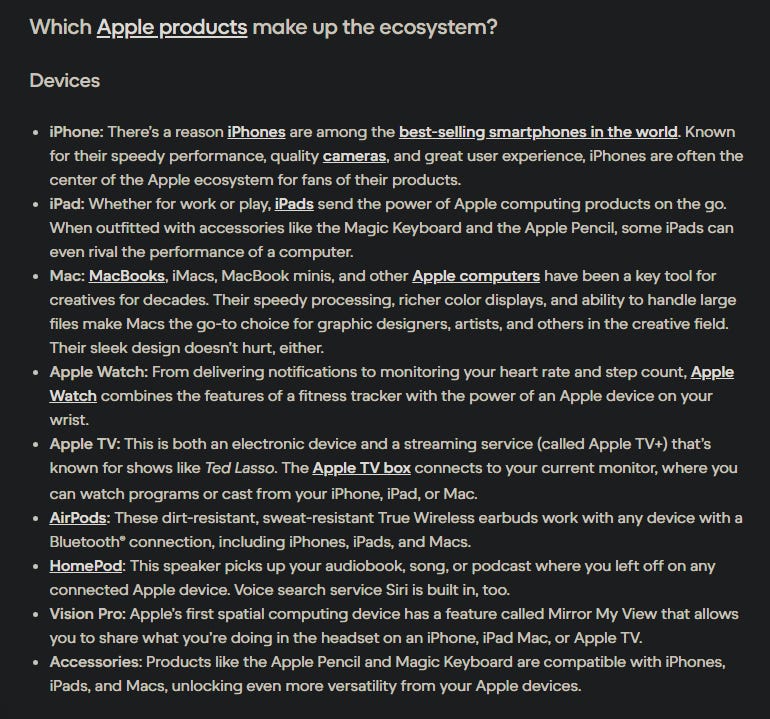
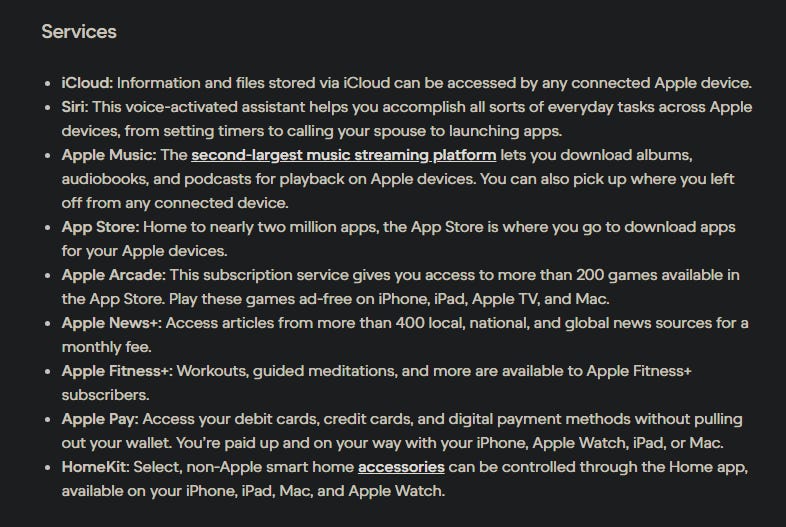
This level of integration is what makes the experience feel seamless. As also discussed in content by Marques Brownlee, the system works well because everything is designed for that environment.
At the same time, this design introduces limits.
Devices often assume that other Apple products and services are already in use. For example, products like the Apple Watch depend heavily on the iPhone to function fully. Outside that setup, their usefulness drops.
Another aspect is scale.
Apple’s ecosystem is not just large in design, but also in reach. A single product line like AirPods generates tens of billions in revenue annually, with estimates placing it in the range of roughly $18–20 billion in recent years. That is comparable to the size of entire standalone companies.
This gives a sense of how deeply these products are embedded into everyday use.
Over time, moving away from the system becomes more complex because as discussed earlier - users are not only switching devices. They are moving away from stored data, app purchases, communication history, and features that connect across devices.
The friction comes from how many parts of daily use are tied together and this does not make the ecosystem inherently negative. It highlights the trade-off. A more connected experience brings more dependence on the same system.
Google
Google, on the other hand, takes a different route, but the outcome is similar.
Instead of starting with hardware, its ecosystem grew from software. Search, Gmail, Google Drive, YouTube, and Android form the base. All of these are tied together through a single Google account, which allows data and activity to move across devices.
Over time, hardware was introduced as well. Pixel phones, Chromebooks and wearables extended the system further.
Compared to Apple, this setup is more flexible. It works across platforms like iOS and Windows. But flexibility doesn’t mean independence. Once you’re logged into a Google account, a large part of your digital activity sits in one place and this kind of integration becomes stronger over time because services are designed to depend on each other.
A good example of this is the Play Store.
On Android, it’s the default source for apps. Alternatives exist, but they don’t offer the same range or reliability. Nearly all users stick with what’s already there.
There’s also another layer.
Many apps rely on Google Play services to function properly. Notifications, location, payments, and other features often depend on it. Even if you install apps from outside the Play Store, parts of them still connect back to Google’s infrastructure.
This makes moving away from the ecosystem harder than it seems.
So while Google’s system feels more open on the surface, it still builds the same kind of dependency over time, just through a different approach.
Why Ecosystems Work So Well
At this point, it’s clear that ecosystems are everywhere. Large companies have them and smaller ones are trying to build them.
The question is why they work so well.
Here’s a hint - convenience is part of it, but it’s not the only reason.
Let’s take a look at the other reasons.
1 - Connected Features
Ecosystems create features that only work when multiple parts are used together. - Services like cross-device messaging, instant file sharing, synced notifications, or shared clipboards depend on this connection.
Individually, these tools might not seem like a big deal but together, they offer something harder to replicate using separate services.
There’s also a behavioral side to it - if using one more device unlocks additional features, an average Joe won’t think twice. He’ll just add it and that’s exactly how the system expands.
2 - Less Choice, Less Effort
Take streaming platforms - you open Netflix or Hulu and get hit with endless options due to which you spend more time deciding than actually watching.
More choices don’t always help and ecosystems reduce that which is why instead of choosing between multiple software or hardware devices - people just end up going for a company that provides an ecosystem which has all the necessary hardware devices or services because that’s what an average Joe needs.
3 - Staying Becomes Easy
When everything is all set up - the go-to decision becomes staying where you are and that means continuing using what already works because switching requires effort and staying doesn’t.
And over time, that turns the ecosystem into the environment where everything happens aka work, communication, storage, daily tasks…etc.
Why? Because it became the easiest option.
The Tradeoffs
The same structure that makes ecosystems work well also creates trade-offs.
Flexibility decreases with the increase of tools. That means switching to another service or device means losing certain features or rebuilding how things work which takes a lot of effort.
And this isn’t about companies trying to make things worse for users, rather it’s more about how systems are designed in a way that makes leaving harder than staying.
There have also been cases where even basic actions were made difficult.
For example, the Federal Trade Commission filed a case against Amazon over its subscription practices, where canceling Prime was described as unnecessarily complicated.
Situations like this show how friction can be built into systems and once you look at it from that angle, you start to see how a more connected experience increases dependence on the same system.
Final Thoughts - Don’t Put Everything in One System
Ecosystems are not inherently good or bad.
They exist because they solve real problems. They make technology easier to use. For the majority of people, they provide real value and voiding them completely isn’t realistic.
The real question is how much you rely on a single system.
Keeping everything in one place makes things simple in the short term. Over time, it also increases dependence. Spreading tools across different systems adds some friction, but it also gives flexibility.
I believe that technology is moving toward more connected systems and understanding how they work is the only thing that will allow you to use them, instead of being used by them.
Make sure to stay tuned for the second part of the tech ecosystem series in which we will be diving much deeper into the system.
One Last Thing
Nearly all people interact with systems without questioning them. This space is about doing the opposite aka understanding how things work, where they fail, and what that means in practice.
If that’s the kind of content you want more of, subscribe. And if this piece added something new to how you see things, pass it on. Good information only matters if it travels.
They key is always to not have all your eggs in 1 basket or else u r effed.