



Hey there 👋
It’s good to have you back.
While working on my last piece on digitization of gambling , I kept running into something strange during research - Prediction markets.
At first, I didn’t think much of it. Then I started seeing odds for elections, wars, policy decisions, even oddly specific future events. And later I realized that these were entire markets.
The deeper I looked, the more unavoidable this became. Instagram reels, YouTube shorts. Clips of people bragging about how much they made by betting on real-world outcomes. Someone won because they predicted this election. Someone else cashed out because they bet on that crisis.
A lot of questions started to pile up in my head.
Why are people trusting markets to predict reality? Why do odds feel more convincing than experts or institutions? And when did forecasting quietly turn into a form of gambling wrapped in data and probability?
And once again I guess, I decided to find the answers to those questions.
You see…gambling doesn’t always look like a casino. Sometimes it looks like insight, sometimes it looks like intelligence. And sometimes, it slips into daily life without you noticing.
In this article, I’ll break down what prediction markets actually are, where they came from, what their growing popularity says about how we understand the future and much more…
Every second counts, let’s continue.
What Prediction Market Actually is
Polymarket or Kalshi are prediction markets. In other words - they are gambling platforms dressed up as forecasting.
On the markets - users are able to bet real money using the USDC stablecoin on who would win. You can wager on everything from the next James Bond actor to whether the U.S. government will confirm the existence of aliens.
What sets Polymarket apart is perception. It’s now regularly cited by mainstream media and amplified by high-profile figures like Elon Musk, who has argued that polymarkets beat polls because real money forces honesty.
At its core, it works by letting people buy and sell shares tied to future outcomes. If the event happens, the share pays out. If it doesn’t, it goes to zero. The price reflects what participants collectively believe, not what’s guaranteed to happen.
Where Prediction Markets Came From
Humans have always tried to price the future. Long before spreadsheets, people were informally betting on wars, royal successions, political outcomes...etc In the 1500s and 1600s, political betting markets were already operating in coffeehouses across Europe.
But it wasn’t as smooth as it is right now.
Prediction markets as a serious concept didn’t emerge until the late 20th century.
In 1988, economists began formalizing the idea that markets could aggregate scattered information better than polls or expert panels. This thinking led to the launch of the Iowa Electronic Markets in 1989, a small academic experiment that allowed participants to trade contracts tied to election outcomes.
Throughout the 1990s and early 2000s, prediction markets gained academic validation. Economists studied them as forecasting tools, not gambling systems. Corporations experimented with internal markets to predict product launches, sales targets, project delays…etc
The idea behind the prediction market was clear - when people have skin in the game, they reveal information more honestly which most of the times lead to more accurate results.
So yes…prediction markets were initially built for forecasting and over time, everything got flipped.
The real public boom came decades later. During the 2024 U.S. presidential election, prediction markets were suddenly everywhere. Odds were screenshotted, shared on social media, cited by journalists, and compared directly with polls. The election acted like a spotlight for prediction markets and that moment changed everything…
How Prediction Markets Gained Momentum
The main reason behind why prediction markets exploded is - the change of environment.
Back in the ol’ days, there was no internet.
But that isn’t the case now.
The internet removed the old gatekeepers. You no longer needed academic credentials, or any permission to participate. At the same time, regulation is slower than ever. Prediction markets didn’t fit neatly into existing gambling, which gave platforms room to operate in legal gray zones while regulators played catch-up.
Crypto accelerated everything. Stablecoins made global participation, bypassing banks, borders, and payment processors frictionless. Suddenly, anyone with an internet connection could participate in markets tied to real-world events.
Once a market starts gaining traction, social media does the rest. Screenshots spread. Wins go viral. Algorithms amplify what performs well, nudging more people towards what it wants them to see.
On top of that - Journalists notice what’s already trending, they along with influencers also start to hop in the shiny train ultimately giving birth to a never ending loop.
That’s exactly what happened with prediction markets.
And if you want to understand how platforms quietly shape what you see, what you believe, and what you pay attention to, I broke it down in detail here:

How Prediction Markets Work
At a high level, prediction markets turn beliefs into prices.
Each possible outcome is represented by a share. When more people believe an outcome will happen, demand for that share increases and its price rises. When confidence drops, the price falls.
As new information appears, let’s say a court ruling or breaking headline or a sudden injury, prices adjust almost instantly. People who react early and correctly are rewarded. Those who guess wrong lose money. That incentive structure is the entire system.
So basically, you’re buying into a probability shaped by the crowd. If the outcome happens, the share pays out. If it doesn’t, then you lose money.
What you’re really seeing is a live signal of collective belief, constantly updated as people put real stakes behind their assumptions. And the market only cares whether you are right or not, it doesn’t give two cents about why you believe something.
Polymarket is also called ‘wisdom of the crowds’ though, it’s partly true because the information can be manipulated via insider trading which is the biggest problem of this system about which we will be talking next.
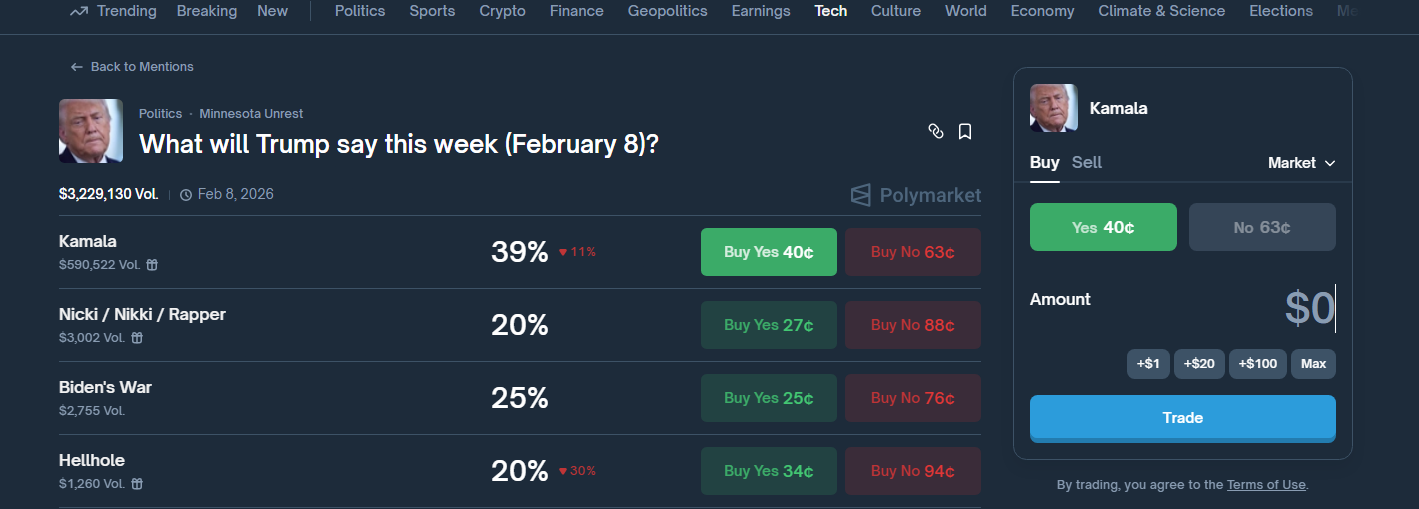
What the Problem with Prediction Market is
The real problem with prediction markets is the asymmetry.
Imagine a streaming platform sitting on a yet-to-be-released finale. There’s a market betting on whether a major character dies. Writers, editors, interns - dozens of people already know the answer. Any one of them can quietly place a bet days or weeks in advance and walk away with easy money.
That’s literally information leakage with a payout.
Some markets are genuinely uncertain. Elections, championships…etc no one has the final answer beforehand. But many Polymarket questions aren’t like that. They revolve around private relationships, unreleased announcements, medical events, or corporate decisions. In those cases, someone always knows what’s going to happen next.
Markets asking whether a celebrity couple will split, or if some celebrity is going to get pregnant or whether a famous CEO will step down…etc These are invitations for insiders, friends, assistants, or employees to cash in on knowledge the public doesn’t have.
This turns many prediction markets into sucker’s games. You think you’re participating in a neutral forecasting tool. But you’re just trading against people who already have the answer.
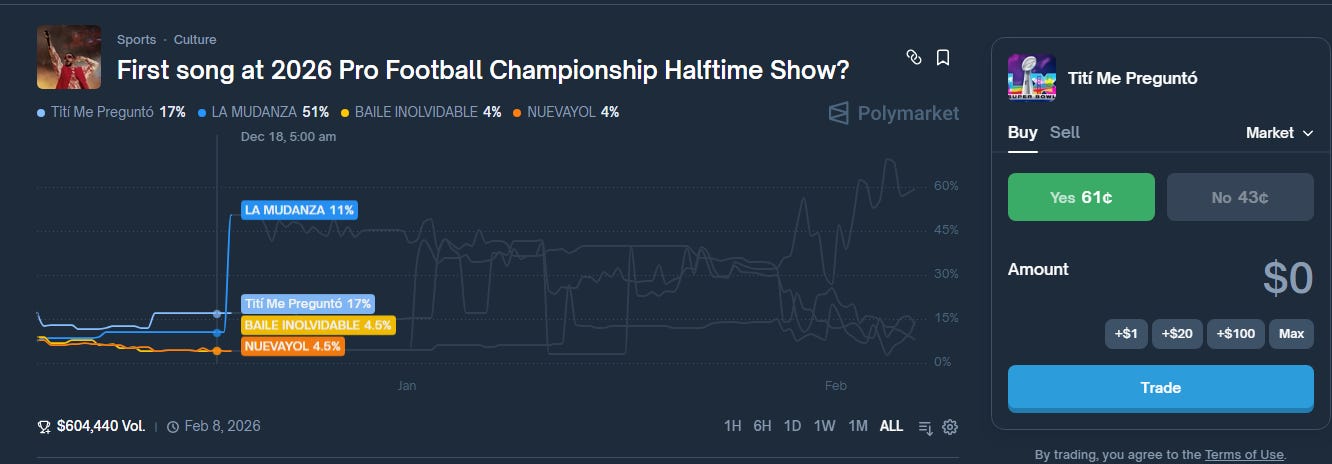
The Grey Zone: Forecasting or Just Gambling?
Prediction markets are sold as sophisticated forecasting mechanisms. The language is polished to make it sound like Wall Street rather than DraftKings - “probability signals”, “information efficiency”, “decentralized knowledge”, “wisdom of crowd”...etc.
Yes, the mechanics are dressed in financial language. Yes, there are probability charts instead of point spreads. But under the hood, it’s simple - risk capital on uncertainty, win if correct, lose if not.
Regulation reflects this ambiguity. In some regions, prediction markets are treated like financial derivatives. In others, they’re classified as gambling. In many places, they operate in a gray zone where neither framework cleanly applies. This inconsistency is a clear reflection of what these markets actually are.
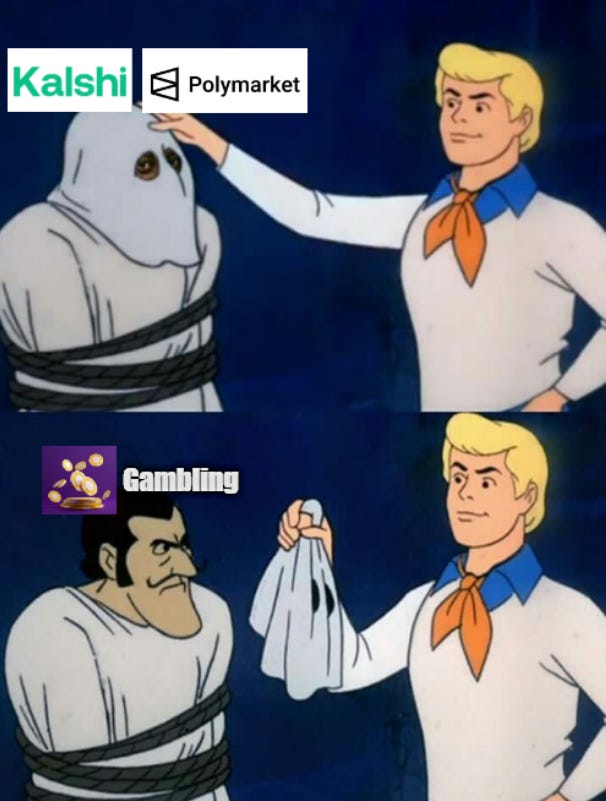
And if you’ve been paying attention to how gambling has been digitalized over the last decade, this should feel familiar.
Fun fact - I recently broke down how gambling is moving online, embedding itself inside video games and different consumer apps. If you want the deeper breakdown of how digital gambling is evolving and realize how prediction market is just another form of gambling, you can check this post out:

How Prediction Markets Are Blending Into Content
Prediction markets are beginning to intersect with the creator economy in subtle ways. These markets aren’t any niche financial tool anymore, discussions about them are increasingly appearing in livestreams and social media.
Streamers do not need to actively place bets to influence participation. Simply discussing probabilities or live market movements is more than enough for promoting these markets.
For example - Atrioc, a youtuber, whose audience already gravitates toward economics and probability-driven analysis, represents the kind of community where prediction markets naturally gain traction - even if markets are not the primary focus of the stream.
The overlap is expanding beyond commentary. Sports figures are also entering the space. Giannis Antetokounmpo recently joined prediction platform Kalshi. This is proof of how the market is slowly growing.
Meanwhile, platforms such as Polymarket routinely host markets tied directly to internet personalities.
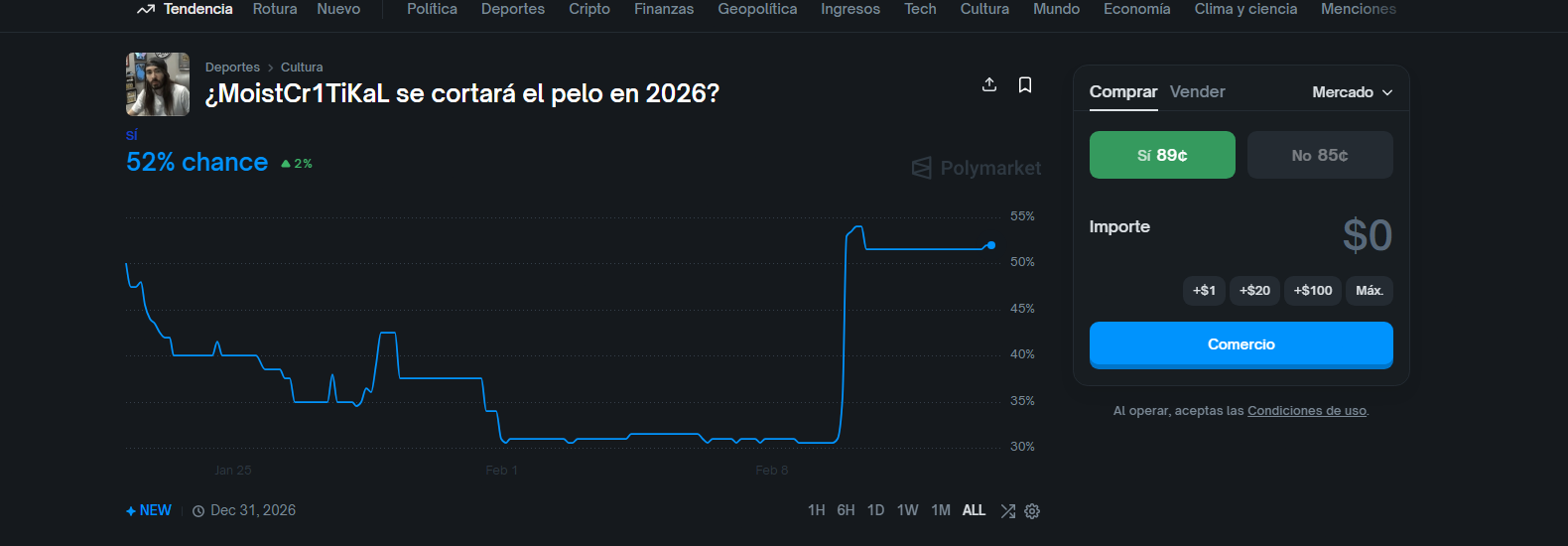
At this point, it’s important to ask - whether viewers are consuming commentary or are they interacting with tradeable outcomes linked to personalities they follow? Makes sense right?
Comment down below and let me know what you think
Just to be clear - none of this is inherently ‘wrong’. But the blending of entertainment, and monetized markets raises practical questions. If a streamer discusses a market, is it organic curiosity or sponsored promotion? In a digital ecosystem where affiliate relationships are not always obvious, audiences may struggle to distinguish between commentary and marketing.
This issue is a whole thing in itself - I explored this dynamic in more detail in a previous piece on how online trust itself has become monetizable and why not every recommendation is neutral:

Case Studies That Made People Question Things
Let’s take a look at real cases that grabbed attention and forced people to think about what goes on behind the scenes of this market.
The $400,000 Maduro Contract That Drew Attention
In early January 2026, one of the most striking stories to emerge from the prediction market world centered on a massive payout tied to Venezuelan leader Nicolás Maduro’s sudden removal from power.
A Polymarket account placed significant wagers that Maduro’s leadership would end by month’s end and those trades were made just hours before a surprise U.S. military operation ultimately removed him from office. When the outcome was confirmed, the bets paid off at near-full value, generating a profit of nearly $400,000.
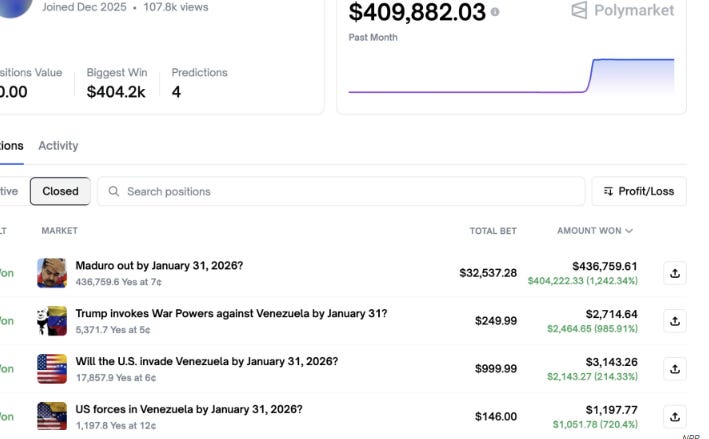
What made the story so crazy was the timing and the mystery surrounding the bettor. The account had been created only weeks earlier and had little trading history outside of these specific wagers. That led many online observers and analysts to ask the same question:
“Was this luck, or did someone have access to privileged information that the broader public and markets didn’t?”
NFL Banning Prediction Market Ads During the Super Bowl
Prediction markets have officially been placed on the NFL’s list of prohibited advertising categories, according to Front Office Sports. A source familiar with the matter told the outlet that these ads were barred not just from the Super Bowl, but from NFL broadcasts throughout the 2025 season.
The Super Bowl is the most-watched television event in the United States. Last year’s broadcast drew an average of 127.7 million viewers across platforms - the largest audience ever recorded for a single U.S. television event, according to Front Office Sports. Thirty-second ad spots have climbed as high as $10 million this year.
So why block prediction markets?
The answer is pretty simple.
The NFL has spent years carefully managing its relationship with gambling. Sports betting is now integrated into broadcasts, but it’s tightly regulated and politically normalized. Prediction markets operate in a much shadier zone.
They don’t sit cleanly inside gambling law.
They don’t sit cleanly inside financial regulation either.
This ambiguity creates legal and reputational risk and the NFL does not gamble with reputational risk during its events.
Allowing prediction market ads during the Super Bowl would effectively place them alongside established sportsbooks. That’s a stamp of approval - A signal to the public that these platforms belong in the same category.
This decision is pretty subtle, but it reveals something bigger if you look closer - Major institutions are cautious about prediction markets because they understand them very well. This matter suggests that even powerful institutions see them as closer to gambling than forecasting and them taking this decision is a sign of that belief.
What This Means Going Forward
I believe prediction markets deserve a more balanced assessment.
Platforms like Polymarket have proven to be useful as information tools. When people put their own money behind an outcome, that creates a stronger signal than a traditional poll. As Elon Musk has pointed out, markets can sometimes be more informative than surveys because participants have financial exposure. Incentives matter.
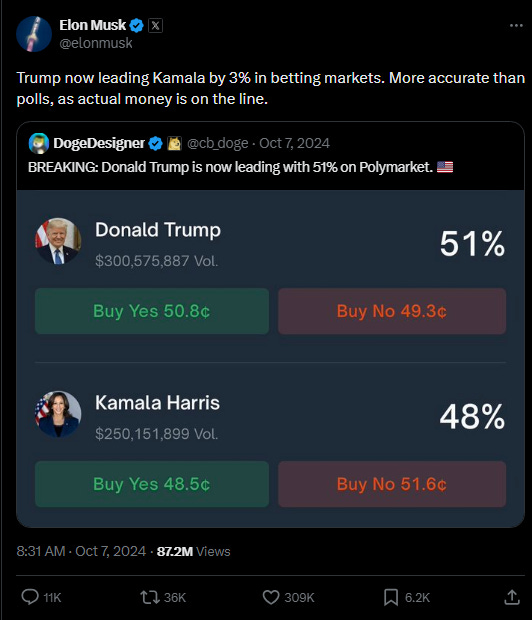
However, a priced probability is still just a probability.
At the same time, their expansion is undeniable. As reported by Forbes, trading volume across major prediction platforms surpassed $3 billion in Q3 2025 alone - more than five times higher than the same quarter a year earlier. Industry estimates project the sector could reach nearly $95.5 billion by 2035, with annual growth rates approaching 47 percent.
And now, the very platform you’re reading this on - Substack - has partnered with Polymarket. Writers can embed live prediction widgets in Notes, showing odds for elections, policy moves, or even celebrity drama, all with real money on the line.
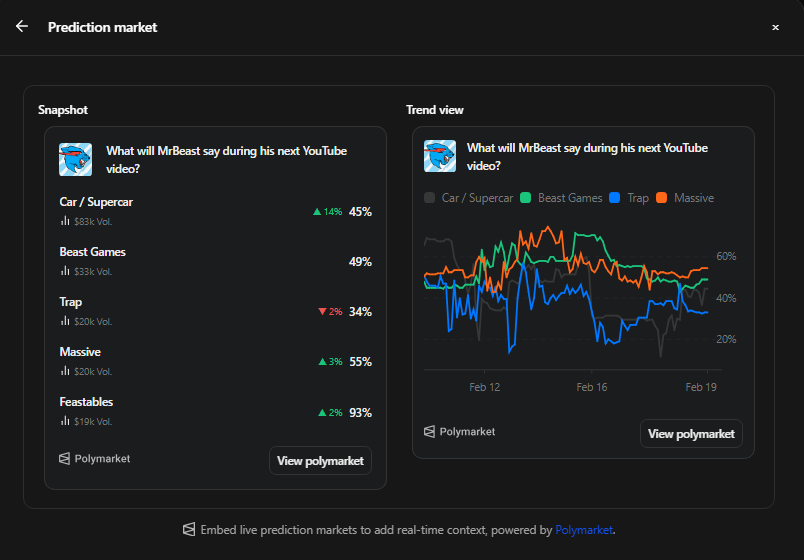
This level of growth suggests prediction markets are growing into something bigger.
In my view - prediction markets will continue to expand, and their influence will likely grow. But growth does not resolve their structural ambiguity between gambling and finance. And expansion does not eliminate uncertainty.
What remains unsettled is how regulators, institutions, and the public will ultimately choose to classify prediction markets. That decision may determine whether prediction markets become embedded infrastructure or not…
Because once prediction markets start influencing journalism and the way people interpret information itself, the conversation changes completely.
And that’s exactly what we’re going to explore in Part 2, stay tuned for that!
One Last Thing
Nearly all people interact with systems without questioning them. This space is about doing the opposite aka understanding how things work, where they fail, and what that means in practice.
If that’s the kind of content you want more of, subscribe. And if this piece added something new to how you see things, pass it on. Good information only matters if it travels.
And if you’re active elsewhere, follow along on Bluesky or X (Twitter) or LinkedIn - those are the two places I show up most consistently outside Substack. A follow, a like, a repost - it matters to me, more than you think.
“What remains unsettled is how regulators, institutions, and the public will ultimately choose to classify prediction markets. That decision may determine whether prediction markets become embedded infrastructure or not…”
i do love how some terms just changes and its essence in the same, but needs different classification and policy.
i wonder what the appetite will end up being here.
i’ve already seen substackers using the new feature. i’m torn. some of it does display some data… but then i feel like im helping enable this mess
Great post. What is concerning to me is the potential for betting against actors with inside information. In this scenario, those who know what will happen and when (attack against Iran, timing of tariff announcement, etc.), can collect a small fortune from those without inside knowledge who think that the chances of willing are 50:50. This is worse than a casino; the house wins all the time. We are seeing this already, and it seems that things will get worse unless those markets are tightly regulated.