



Hey there👋
You’ve probably heard of the dark web. Maybe you’ve heard that visiting it can get you hacked, that it’s full of criminals, or that simply accessing it puts your computer at risk.
A lot of those claims come from the way the dark web is portrayed online. Podcasts, YouTube videos, news stories, and social media have turned it into something far more mysterious than it actually is.
That doesn’t mean there’s nothing concerning about the dark web. Criminal marketplaces, stolen data, scams, and other illegal activity do exist there. But the dark web itself is a technology, and understanding how it works is different from believing every story told about it.
Side note: The goal of this article is to explain how the dark web works and clear up some of the common misconceptions around it. This follows our previous piece on the history of the internet, where we looked at how the internet came to be.
So, what exactly is the dark web, and how does it differ from the internet you use every day?
Let’s dive into that.
What are the Different Layers of the Internet?
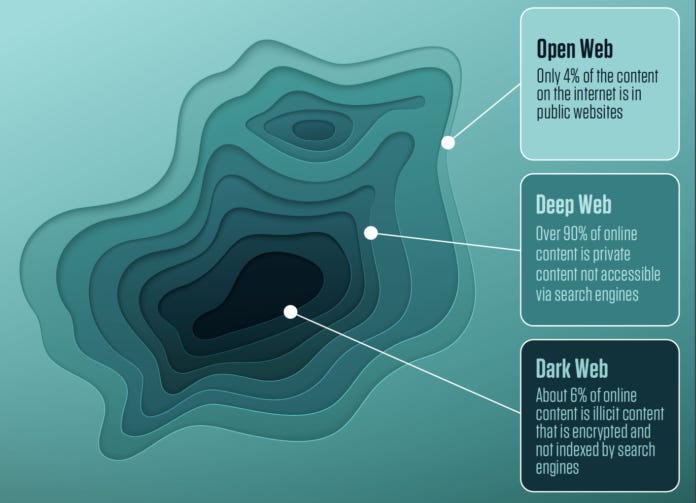
Most of us don’t even realize that the internet which we use as a part of our daily life is just the tip of the iceberg. The internet that we know of is actually composed of three different layers.
Surface Web (The Public Web)
The surface web includes content that is easily accessible by everyone on the Internet including me and you. You can think of this layer of the Internet as the Visible layer. Unlike the dark web and deep web which are not indexed by any of the search engines, the surface web is indexed by every kind of search engine, this is the topmost layer of the internet which you are currently using to access this article as well.
To simplify it even further, any kind of content or resource you can access on the Internet without any special kind of permission which includes a login falls under the category of Surface Web. The Interesting thing is this layer consists of only 10% of the total internet, meaning that most of the web is hidden beneath the surface.
Deep Web (The Hidden Web)
This is the second layer of the Internet which makes up 85% of the Internet, the kind of content that can only be accessed using login pages. This isn’t available to everyone. You might be wondering if you can access it without the usage of any special browsers like TOR. The answer is you probably access it every single day with just your normal browser.
To simplify it even further, when you access something as simple as your Gmail, you already are lurking in this layer of the Internet. Ask yourself “Can some random uncle from the street without knowing your login, access your Gmail?” No right?
In short, the Deep Web is simply just private and needs some kind of authorization to access. Things like Medical records, private social media accounts, University databases are all part of the Deep Web.
Dark web (The Anonymous Web)
The dark web is only a tiny part of the Internet making up only 4-5% of the Internet. It can only be accessed using specialized networks like TOR. People think the dark web itself is illegal but that is not true.
As I mentioned earlier due to it being anonymous, people who want to stay really safe just use it for its privacy features although due to it being anonymous, but illegal activities such as drug selling and much more do take place there.
Intro to Dark Web
The dark web is a hidden part of the internet not indexed by regular search engines. When I say that it is not indexed, it means websites on the dark web don’t show up on Google, Bing or any other normal search engine.
Dark web websites are hidden and can only be accessed through special browsers like the Tor Browser, which allows people like us to surf the internet anonymously.
Undoubtedly, you must heard about it being the hideout for criminals and it is but that is not all that the Dark web is. It serves other purposes as well. It's primary use is not just for illegal things.
At the end of the day, it all comes down to who is the one behind the screen using it.
Why Does it Exist?
The primary reason for the creation of the Dark web was not illegal activities, when people refer to the Dark web they are basically just referring to software like Tor, P2P, and technologies like these that help people stay anonymous.
The actual location of individuals remains unknown so they can communicate without having to worry about others knowing where they are. There are some other key reasons for its existence as well which are the following.
Freedom of Speech
In many countries, governments heavily restrict online content. The dark web allows people in these countries to access such restricted content which include blocked websites, the sharing of different kinds of information. It also allows people to discuss ideas that are normally suppressed by governments.
It proves to be a good platform for those who want to be heard for their ideas and who want to disclose the reality of many things without being dragged out of their house and gunned down.
Whistleblowing and Journalism
This platform is very important for whistleblowers and journalists. These individuals are the true heroes of our society who expose the nasty stuff going on inside governments and corporations. Whistleblowers cannot go on media and expose the governments, if they do they face serious consequences and I am talking about life and death right here.

Anonymity tools like SecureDrop which is a platform on the Dark web, offer a secure way for whistleblowers to send any kind of documents or share messages with journalists without revealing their identities.
Privacy and Anonymity
One of the main reasons people use the dark web is privacy. Technologies such as Tor can make it harder to trace where a connection comes from, while encrypted communication can help protect what is being sent. That can be useful for people who need to communicate or access information without exposing their identity or location.
But privacy and security are different things. Being harder to identify does not mean you are automatically protected from scams, malware, surveillance, or other risks. The same tools that can protect someone’s privacy can also be used for things that are far less harmless.
I’ve written more about this distinction in my privacy series, where I break down different parts of digital privacy, from authentication and communication to browsers and online behavior.
If you want to understand why privacy matters and how the different pieces fit together, those articles are a good place to start:


The broader point is that privacy itself isn’t suspicious. In many cases, it’s something people need. Journalists, activists, researchers, whistleblowers, and ordinary people may have legitimate reasons to keep their identity or online activity private.
The dark web happens to provide some of the tools that can make that possible. What people do with those tools is a separate question.