
Hey there 👋
Let’s begin with a question. What comes to mind when you hear of the term “gamer”?
My guess is, it’s someone on a couch with a controller in hands, TV glowing in the center room.
Or maybe it’s a PC setup with RGB lighting which alone costs more than my laptop.
That’s the general image gaming culture has spent decades building. But here’s the thing. That image is wrong. Or at least, it no longer holds true thanks to the rise of mobile gaming.
The biggest gaming platform in the world right now is sitting inside your pocket without many of us knowing.
It’s been there this whole time, we just weren’t paying that much attention. And it’s not just us, big players in the gaming industry ignored it for quite some time too.
Yet now, all the big players which includes Sony, Microsoft, Nintendo, and even Valve are all scrambling to get a piece of it.
Mobile gaming isn’t a side category anymore. It’s the main event. And most people have absolutely no idea.
Even though I wasn’t sure that the mobile gaming market is that big, when I saw the numbers for my recent article on Carcinization in the Gaming Industry, I was somewhat shocked.
Mobile gamers who most hardcore gamers don’t even like to call gamers have given rise to an industry that is double the revenue and 5x the size of the console market.
This realization was the idea for this article. Initially I thought of mentioning it in a small section in the Consoles and Carcinization article.
But there was a lot more to this topic so I had to dive deep and write a proper article explaining where this whole thing started and where the mobile gaming space is headed in the years to come.
The Surprising Numbers
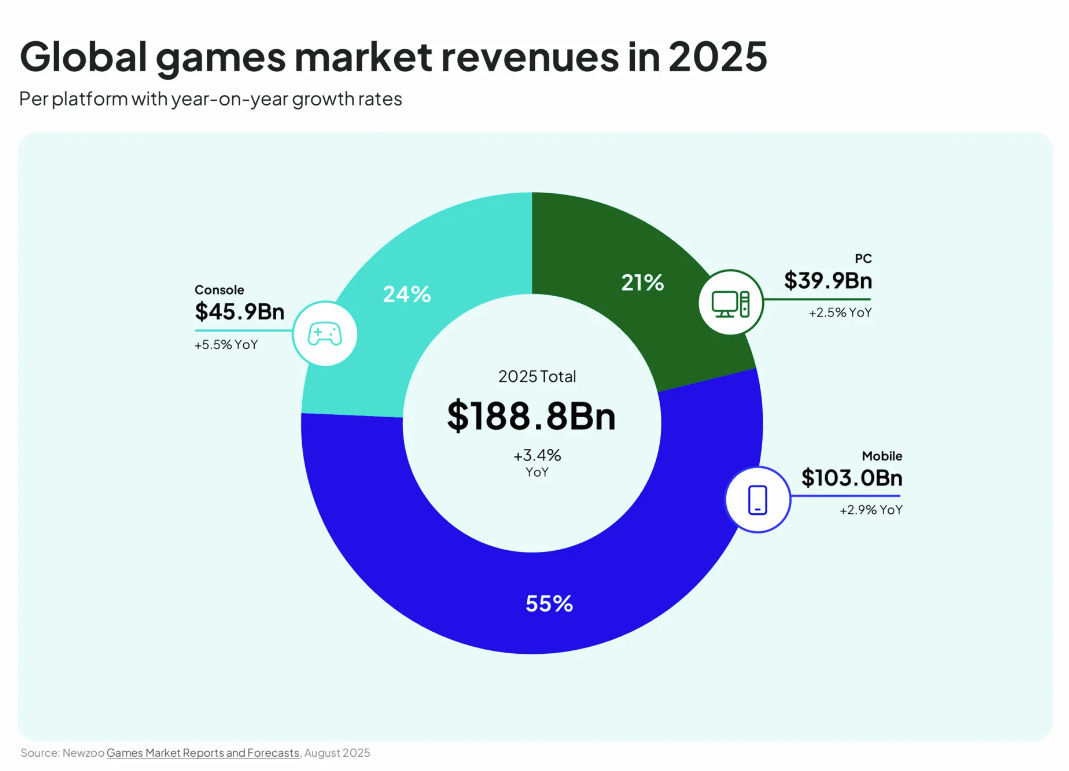
I’ll just say it at the start. Mobile gaming made roughly $103 billion out of the total of $188 billion the entire gaming industry made in 2025. Yes, that’s BILLION with a B.
Just let that sink in for a second.
Console gaming which includes your PS5s, Xboxes and Nintendo Switches of the world pulled in $45 billion. And PC gaming came in 3rd pulling in $39 billion in 2025.
The entire global gaming market was worth roughly $188 billion in 2025, and mobile alone is carrying nearly half of that number. By itself. From the phones in people’s hands.
There are 3.4 billion mobile gamers in the world right now. Compare that to roughly 630 million console players. Mobile gaming isn’t just bigger, it’s in a completely different league.
And yet, if you asked most people around you to name the biggest gaming platform, I’d bet they’d say PlayStation or Xbox before they even thought about their phone. That gap between what we think and what the numbers actually are, is exactly what this article is about.
Isn’t Mobile Gaming just Candy Crush?
I know what you’re thinking. Okay, a lot of people play phone games. But it’s all Candy Crush and Subway Surfers and ads every 30 seconds. That’s not real gaming.
I used to think the same thing, honestly. I would laugh at mobile guys even calling themselves “gamers”. But the numbers and the impact speak for themselves.
It’s hard to find students who in the COVID days haven’t tried PUBG Mobile at least once. Even if you didn’t play it you almost certainly have heard it make headlines.
I remember jumping ranks and grinding for new costumes like it was my full-time job during lockdown days :p
PUBG Mobile generated over $3 billion in revenue in a single year. Mobile Legends has tournaments with prize pools that rival traditional Esports.
These are not simple games, not even cheap to make actually. They’re built by massive studios with hundreds of developers, cinematic trailers, and dedicated competitive scenes even in countries like Pakistan.
Honor of Kings, a mobile MOBA (Multiplayer Online Battle Arena) also made by Tencent crossed $2 billion in annual revenue in 2024 with over 100 million daily players.
Just for context, that’s One Hundred Million people playing one game, every single day. That’s not casual. That’s a media empire that basically lives on our phones.

Genshin Impact crossed $10 billion in lifetime player spending faster than any mobile game in history.
And mind you, this game has console-quality graphics, a massive open world, regular content updates, and a player base that would make some AAA studios jealous.
The Candy Crush phenomenon kinda exists in the sense that casual games loaded with ads still exist and make a lot of money. But dismissing actual mobile gaming because of these games is just not a good strategy.
The Math Is Mathing

Let’s actually break down where mobile’s $92.6 billion in the year 2024 comes from because the breakdown seriously hits the eyeballs.
In-app purchases made up about $80.9 billion of that $92.6 billion number. Advertising brought in $18.9 billion. Subscriptions are a small but growing slice on top of that.
Here’s the interesting part though. Downloads are actually going down. There were 49 billion mobile game downloads in 2024, which is down 7% from the year before.
Fewer people are downloading games yet the spending is going up, sounds weird, right?.
But that just means that existing players are spending more money per person, not that new people are flooding in. And that’s what makes the total number go up.
Strategy games led all mobile genres at $17.5 billion in revenue. This includes games like Clash of Clans or the one I used to play, Clash Royale.
RPGs followed strategy games at $16.8 billion. These are not Candy Crush numbers. These are genres that require real time investment, learning, and often a decent amount of money spent inside the game.
And this isn’t slowing down anytime soon. Mobile gaming is projected to go over $130 billion in 2026 and the numbers only balloon up when you look at projections for the end of this decade.
If 2024 shows roughly $90 billion revenue, just imagine what the numbers would look like by 2030 if the mobile gaming industry keeps on growing as is.
So, Who Actually Plays Mobile Games?
Here’s where it gets really interesting from a global perspective.
Asia Pacific (which includes our Pakistan) generated 49% of all mobile gaming revenue in 2025.
Basically, nearly half the world’s mobile gaming money comes from one region. China alone generates over $40 billion annually, which is more than the entire console market in most other countries.
India is the next one to watch. 450 million gamers, getting by with their sub-$100 smartphones and some of the cheapest mobile data plans in the world.
Despite that massive player base though, India generates only 1.1% of global gaming revenue right now.
That gap between the number of players and the amount of money being spent tells you exactly where the next wave of growth is coming from. Game publishers are already paying very close attention.
Japan and South Korea punch way above their weight. Average revenue per user in those markets is above $80, which more than makes up for their smaller populations.
But here’s the stat I find most interesting whenever this topic comes up. The average mobile gamer is 36 years old. And 46% of gamers worldwide are women.
The image of a skinny teenager in a dark room with a headset was simply never accurate for mobile.
The Business Model that Prints Money
Okay so we know mobile gaming is massive. But how exactly is it making this much money? Because most of these games are free to download. I’ve played games like Clash Royale and I’ve never spent a single rupee.
The answer is the free-to-play model, and once you understand how it works you’ll start seeing it everywhere.
Zero upfront cost removes the biggest barrier to trying anything. You don’t have to decide if a game is worth Rs. 3,000 before you’ve played it. You just download it and start playing.
The risk of trying a game is zero and so are the requirements when it comes to your smartphone. Most mobile games run well on phones that aren’t even bleeding-edge.
Once you’re playing and invested in the game - your characters, your progress, your ranking - that’s when the real product reveals itself. Skins, extra lives, characters, battle passes, random loot drops you pay for.
That’s what got me hooked on PUBG in lockdown days. Once you’ve spent time pas a couple seasons and your character has leveled up, you just want to keep going and spending real money enters the equation sooner or later.
This is the reason In-app purchases brought in $80.9 billion to the mobile gaming market in 2024 alone.
The gacha mechanic deserves a special mention because it’s basically a slot machine dressed up as a game feature.
If you haven’t heard of the gacha system or want to know more about how gambling is implemented in video games, check out this recent article from my fellow writer Mohib here at SK NEXUS.
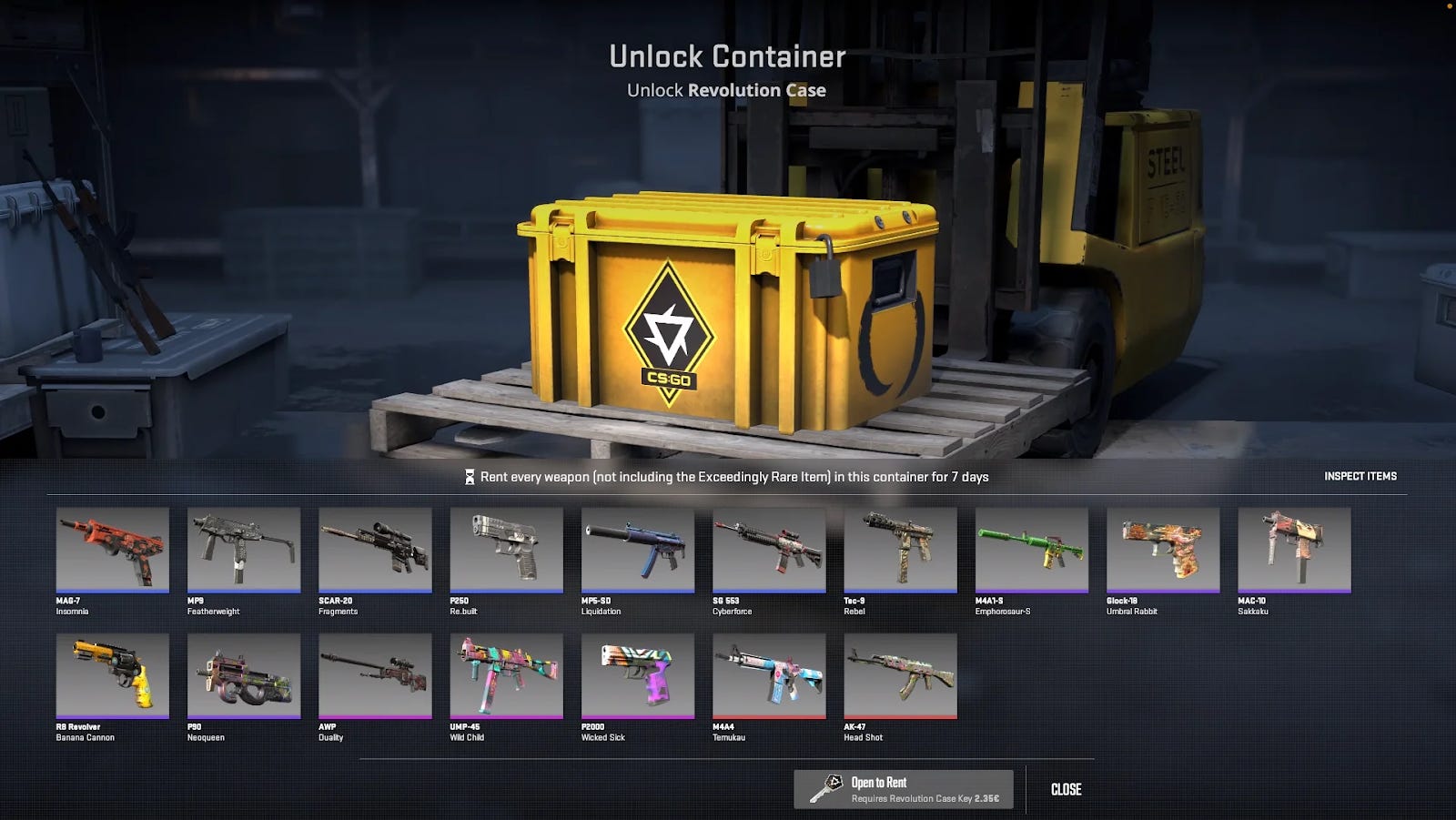
In short, you spend currency - either earned slowly in-game or bought with real money for a random chance at a rare item. Basically, how lootboxes work in Counter-Strike.
Genshin Impact built its entire economy around this. Players have spent thousands of dollars chasing specific characters.
One player famously spent over $10,000 on a single banner without getting the character they wanted. Now, that’s a shame :/
However the regulators are starting to notice this. The FTC hit Epic Games with a $520 million settlement over Fortnite’s use of dark patterns - design choices that tricked players, including kids, into spending money they didn’t mean to spend.
Valve also just got hit with a lawsuit over Counter-Strike lootboxes. Europe is actively debating loot box regulation.
This is a business model that has worked for quite some time and still works brilliantly, but it’s starting to face its first real legal challenges.
Sony is waking up to mobile, slowly and awkwardly
Sony is one of the most interesting cases in this whole story because they clearly know what they need to do, they’re just not very comfortable doing it.
In 2022, Sony set up a dedicated PlayStation Mobile division and acquired a studio called Savage Game Studios specifically to build mobile titles.
Their internal target is to have 20% of PlayStation’s first-party output on mobile by 2026. That’s a very specific number for something companies only announce when they’re serious.
Although Sony’s problem isn’t money or talent. It’s culture.
PlayStation built its identity on prestige console experiences. God of War, Spider-Man, The Last of Us.
The internal feeling at many of these studios is that mobile is a step down. Getting developers who spent years creating 40-hour story-driven games to suddenly care about a free-to-play mobile experience is a genuine challenge.
But Sony watched Call of Duty Mobile and Diablo Immortal - both are mobile versions of massive console franchises and they become billion-dollar mobile games, that’s hard to ignore for Sony.
Sony has an incredible IP sitting on the shelf. God of War on mobile is not an insane idea. It’s actually a very logical one if the implementation is right.
Sony has marked roughly $12 billion for strategic investments between 2024 and 2026. Mobile is explicitly mentioned on that list.
Microsoft Wants Xbox Everywhere, Literally!
Microsoft’s strategy is more aggressive and more interesting than Sony’s, partly because they already made their big move.
The Activision Blizzard acquisition for $68.7 billion (the largest acquisition in gaming history) was not primarily about console gaming. Microsoft paid that much partly to get King.
King is the studio behind Candy Crush, and Candy Crush alone generates over $2 billion annually just from mobile. Microsoft bought an entire mobile gaming business as part of that deal.
Beyond that, Microsoft has been building toward a world where “Xbox” is not a box you plug into your TV but a service you access from anywhere.
Xbox Cloud Gaming lets you stream games to your phone right now. The quality is genuinely good if you have a stable connection. Sadly, we in this part of the world shouldn’t be too happy about cloud gaming anytime soon.
Microsoft tried to build a dedicated Xbox mobile store for Android but hit a wall because Google’s Play Store policies blocked it. That legal battle is still going on.
If the legal battle resolves in Microsoft’s favor, they could sell Xbox games directly on Android phones without giving Google a cut. That is a very very big deal.
Microsoft’s pitch is simple - you own a game, you should be able to play it anywhere. On your console, on your PC, on your phone.
That actually sounds cool on the surface and mobile is central to making it work. But I won’t be getting too hyped about Microsoft anytime soon I guess.
Nintendo - The Silent Player
People talk about Sony and Microsoft’s mobile strategies like they’re new ideas. Nintendo figured this out almost a decade ago and most people missed it.
Mario Run launched in 2016. Fire Emblem Heroes launched in 2017 and has quietly generated over $1 billion in revenue since then.
Almost nobody talks about that number. Animal Crossing: Pocket Camp built a dedicated mobile audience that existed completely separately from the console version.
But Nintendo’s mobile strategy is genuinely different from Sony and Microsoft’s.
Nintendo doesn’t use mobile to replace console revenue. They use it as a marketing funnel to sell more Nintendo Switches.
Their strategy is to get someone hooked on a mobile Fire Emblem game and they’re a much easier sell for the full console experience.
The Switch itself is maybe the clearest expression of Nintendo’s philosophy.
It basically is a console you can take anywhere, play on your TV at home, or hold in your hands on a bus. It blurs the line between console and mobile gaming in a way that nothing else does, maybe except the SteamDeck.
The Switch 2 sold 1.6 million units in its first month in the US alone in 2025, which tells you the hybrid model is very much working.
Nintendo is not chasing mobile the way Sony and Microsoft are. They already built their mobile strategy into the hardware.
Valve Just Joined The Chat
Valve dropped a bombshell when it recently announced its upcoming hardware. People have been onto the hardware ever since, but there’s a fresh news that most people haven’t fully processed yet.
In November 2025, Valve announced the Steam Frame - their upcoming VR headset running on a Snapdragon ARM chip that natively supports Android APKs.
The Steam Frame is a different beast and pretty much the most exciting thing that’s going to happen to gaming on VR. I wrote an in-depth article discussing its features linked here.
What supporting Android APK means in plain language is that Android mobile games can run directly on Steam without any porting or conversion work from developers.
A Valve engineer (Jeremy Selan) described the goal as making it so players “don’t even have to think about” what device their game is running on. Focusing on just that sentence tells you Valve’s entire strategy.
Valve has also been quietly funding Fex, an open-source Windows emulator for Android. This powers something called GameHub, which lets you play Steam games on your phone.
It’s not a finished product yet and may not launch with the Steam Frame at launch, but Valve confirmed that it’s serious about it. And considering the possible delays of Valve hardware, it’s possible that this may just launch with the hardware (if it releases)
The long play here is potentially quite massive for Valve and gamers in-general.
If Google’s Play Store faces enough regulatory pressure to open up (which is very much being debated in courts right now) Steam could start selling games directly on Android phones.
With no cut to give to Google that would mean Steam’s existing library available on your phone, bought through Steam themselves.
If this happens this would completely change the mobile gaming landscape.
Pakistan and Mobile Gaming
There’s a reason Asia is the leader in mobile gaming adoption. Countries including Pakistan, India, Bangladesh have large smartphone adoption and low-incomes to justify expensive PCs and consoles for video games alone.
This is part of the reason why Pakistan has over 34 million online gamers, 60% percent of which are mobile gamers while the 30% are on PCs and the rest of the 10% on gaming consoles.
As we’ve discussed many times before, Pakistanis mostly earn in PKR and spend in USD so the majority of households are kicked out of owning dedicated gaming machines.
But smartphone adoption is already at roughly 70-80% of the entire 250 million population of Pakistan. And that’s what makes our local mobile gaming scene more exciting.
Fortunately, we’ve also seen an increase in gaming overall through world champions like Arslan Ash and that has allowed for a surge in gaming in-general in Pakistan.
This has also translated to mobile gaming with big banks like HBL regularly sponsoring gaming tournaments as well international platforms like IGN also being available here.
Pakistan has also started developing a very small game development scene that also covers mobile games but that space is quite niche and is quite recent.
That’s not to say all is hunky and dory. Some game creators have found it difficult to monetize their work especially because of the low in-game ads that pay out 1-1.3 cents for a 1,000 impressions compared to $20 in USA and similar developed markets.
Even though we have yet to produce a mobile game that makes it big we still can be happy about some progress being made in this area.
The fact that we have started to look towards promoting any digital industry in the background of brick and mortar industries like textiles and clothing.
The Dark Side to Mobile Gaming
I’ve spent this whole article making mobile gaming sound like the greatest thing since sliced bread. And look, the numbers are real, the growth is too.
But I’d be lying if I wrapped this up without talking about what’s happening behind the scenes.
Because mobile gaming, more than any other gaming platform, has a serious dark side. And it’s one that the industry has been very deliberately quiet about up till pretty recently.
Let’s start with how these games are actually designed.
The term you need to know is “dark patterns.” It sounds like something from a sci-fi movie but it basically means design choices that are intentionally built to confuse or trick you into spending money you didn’t mean to spend.
In mobile games this shows up in sneaky ways. Buttons placed so close together that you accidentally tap the “buy” option when you meant to close a menu.
Games that wake from sleep mode and charge you before you’ve even looked at the screen. Currencies that are deliberately confusing - you buy 1,200 “gems” for Rs. 1,500, and then a character costs 950 gems, so you can never quite figure out what you’re actually spending in real money.
This is not a conspiracy theory. The FTC sued Epic Games over this exact behavior and won.
Epic paid $245 million in consumer refunds and a separate $275 million penalty for collecting data from kids under 13 without telling their parents - a total of $520 million, the largest gaming settlement in FTC history.
The complaint described how Fortnite’s button layout led players to get charged while “attempting to wake the game from sleep mode, while the game was in a loading screen, or by pressing an adjacent button.”
And then there’s the kids problem. Mobile gaming is everywhere. The phone is the most accessible screen in any household. A seven-year-old doesn’t need to ask their parents to switch on their iPad - they just pick up their tablet sitting on the table and open a game.
Most of these games are designed for all ages on the surface, but the monetization underneath is built for adults with credit cards. The problem is that kids don’t always know whose credit card is whose.
There are parents who have discovered hundreds of thousands of rupees worth of in-app purchases on their bills, made by children who genuinely didn’t understand they were spending real money.
The virtual currency systems in these games are specifically designed to create that confusion. You’re not spending money, you’re spending “coins” or “gems” or “V-Bucks.” It feels like Monopoly money until the bank statement arrives.
The addiction angle is also something the research community has been taking increasingly seriously.
The World Health Organization formally included Gaming Disorder in the International Classification of Diseases in 2018, recognizing it as a legitimate condition and not just parents being dramatic.
Research specifically on mobile gaming found that long hours of phone gaming in particular (more than computer or console gaming) showed the strongest links to poor well-being scores in adolescents.
The phone is always there. There’s no natural stopping point the way there is when you turn off a TV. You’re lying in bed at 2 AM and the game is right there in your hand.
And honestly, I’m a witness to this. My 4 year-old nephew has his eyeballs glued to his tablet playing Talking Tom Gold Run. And especially while playing it, it’s like he’s just hypnotized into the game.
China, which generates more mobile gaming revenue than almost anywhere else, got so worried about this that the government stepped in.
They introduced hard limits on how long minors can play online games - a maximum of one hour on weekdays and three hours on weekends, with a complete ban between 10PM and 8AM.
That’s the government of the world’s biggest mobile gaming market deciding the industry couldn’t regulate itself.
Europe is actively working on loot box regulation. Belgium already banned them outright in 2018. The Netherlands followed. More countries are in the conversation.
None of this means mobile gaming is bad. It means it’s a powerful thing, and powerful things need honest conversations around them.
The same way we talk about social media’s effect on teenagers, or the way junk food is marketed to kids, mobile gaming deserves the same scrutiny.
The business model works brilliantly for the companies. The question is who bears the cost when it works too well.
The industry knows all of this. They have researchers and psychologists on staff whose literal job is to figure out how to keep you playing longer and spending more.
That’s not speculation - it also came out in the Epic lawsuit. Internal documents showed employees flagging the dark patterns as problems, and being ignored for years.
That’s the part of the $92 billion story that usually doesn’t make it into the press releases. But progress is being made on this end too.
What The Future Looks Like?
Moving back to the global landscape, here’s where we currently are:
Mobile gaming is already the biggest platform, both by the revenue and the number of players. The money in mobile gaming speaks for itself.
What’s changing now is that the companies who spent decades building consoles and PC gaming are finally accepting that reality and building towards it.
Microsoft bought King.
Sony built a mobile division.
Nintendo made the Switch.
Valve is building Android support into Steam.
These are not coincidences. These are companies that read the same revenue numbers you just read, and decided they needed to be in that market. This is a battle to establish foot into the mobile market.
Cloud gaming is the bridge that makes all of this work at scale. Xbox Cloud Gaming, PlayStation Remote Play, NVIDIA GeForce Now - these services remove the hardware requirement entirely.
You don’t need a console. You don’t need a gaming PC. You need a phone and a decent internet connection and even though Cloud gaming sucked initially, it’s gotten way better.
5G is making that connection reliable enough for real-time gaming in more and more places. South Korea and China already have gaming-grade 5G network slices with sub-20ms latency.
This is the same latency we Pakistanis get on our broadband connections at our homes.
As that infrastructure spreads, the gap between mobile gaming and console gaming shrinks further. And in that regard we’re also hearing about the 5G auction in Pakistan although I don’t really know how it materializes.
But still, good to know I guess :p
And then there’s Africa, which is projected to grow at 12.5% annually through 2031 in mobile gaming.
The next billion players are coming from markets that are going to skip consoles entirely - the same way large parts of the world skipped landlines and went straight to mobile phones.
The lines between console, PC, and mobile are genuinely starting to disappear. Valve’s Steam Frame is maybe the clearest single example of that. But it’s happening everywhere, slowly and then all at once.
Mobile gaming didn’t sneak up on the gaming industry. It looks like the industry was just too self-involved and now mobile is out there giving everyone reality checks.
As always Thanks for taking the time to go through this deep-dive article. Every month we do one of this going head-first into topics we find interesting.
I love reading your comments so feel free to leave your feedback down below.
And before you leave here’s a question for you:


