



Hey there 👋
In Part 1 of the series, we learned how the creator economy was built on the idea that content itself was the business. Views turned into ad revenue, ad revenue turned into a living, and the work stood on its own.
But Part 2 showed why that model is under pressure, why platform revenue has become less reliable, and why trust has become harder to measure.
This piece looks at what creators are doing about it, and whether any of it addresses the deeper problem or just works around it.
What Creators Are Doing
Ad revenue has gotten less predictable. Platform reach has gotten harder to count on. AI has made content cheaper to produce at scale, and manufactured trust has made it harder for audiences to tell a genuine recommendation from a coordinated one.
That’s the environment creators are operating in right now, and it’s pushing them in two directions. Some are moving closer to traditional business by building physical products around their audience. Others are focusing on direct relationships that reduce how much they depend on any single platform.
Neither approach removes the underlying problem. But both show how creators are adapting to a system that’s gotten harder to rely on.
Let’s take a look at both of these approaches that creators are using to survive in today’s economy.
Approach 1: Building Businesses Beyond Content
One of the clearest responses to declining content value has been creators moving into physical products.
Digital content can now be produced and copied at a scale that makes it harder to hold value, but physical products don’t work that way. They require manufacturing, supply chains, and real investment, which makes them harder to copy and easier to defend.
For creators with large audiences, that difficulty becomes the opportunity. Years of built-up attention becomes the distribution channel for a product business.
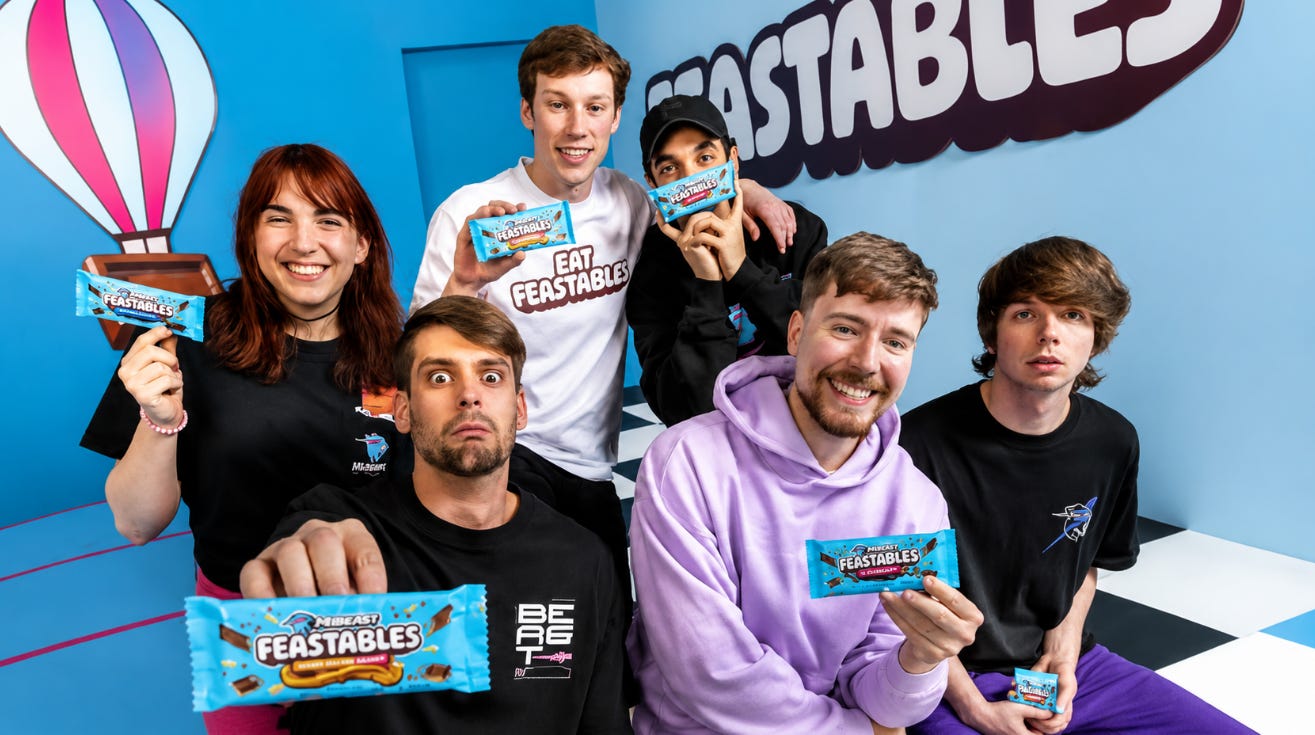
MrBeast launched Feastables, a chocolate brand built around his audience, in January 2022. Feastables generated $250 million in revenue and $20 million in profit in 2024, which made a chocolate bar brand more profitable than the largest YouTube channel on the planet.
Similarly, Logan Paul and KSI’s Prime Hydration shows how quickly a creator audience can turn into a consumer business. Bloomberg reported that Prime was on pace to surpass $1.2 billion in sales in 2023, up from $250 million in its first year.
But the growth did not last. The story is useful because it shows both the upside and the limits of turning audience attention into a product business.