



Hey there 👋
Over the past year, I’ve written quite a few history articles.
The History of Computers
The History of Hacking
The History of the Internet
The History of Telephone Networks
A few days ago, I was sitting and looking through some of those articles when my phone caught my eye.
And I realized that I’ve spent thousands of words writing about the technologies that eventually led to this device sitting on my desk, but I’ve never actually looked into the history of the phone itself.
We still call it a phone, but if you zoom out a little, that description feels increasingly outdated.
The device in your pocket is a camera, a computer, a GPS receiver, an internet terminal, a gaming console, a payment device, and one of the primary ways people communicate with each other.
In fact, the “phone” part has become one of the least interesting things about modern smartphones.
A lot of people spend far more time texting, scrolling through social media, browsing the internet, watching videos, listening to music, navigating with maps, and using apps than they do making actual phone calls.
But the smartphone didn’t start that way…
So in this article, we’re going to look at how mobile communication evolved from bulky radio systems and experimental networks into the smartphones that billions of people carry every day.
Before Mobile Phones
The World of Landlines
For most of the twentieth century, communication was tied to physical locations.
Telephones existed, but they were attached to places instead of people.
If you wanted to call a person, you called their house or office and if the person you wanted to reach wasn’t there, communication stopped. You could try again later, leave a message with someone nearby, or simply wait until they returned.
That was normal.
For a long time, nobody expected to be reachable at all times because the technology simply didn’t allow it.
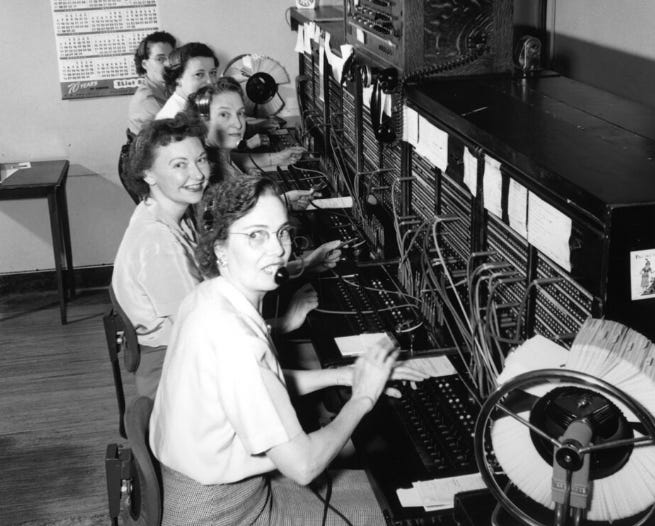
Telephone networks themselves were remarkable engineering achievements. By the middle of the twentieth century, operators and switching systems could connect conversations across cities, states, and eventually countries. The Bell System in the United States built one of the largest communication networks the world had ever seen, connecting millions of households and businesses through an increasingly sophisticated web of wires and switching centers.
But the main problem was mobility and that limitation became increasingly noticeable as society grew more connected.
Radio Opens a Different Path
While telephone networks were expanding across cities and countries, radio, another communication technology, was developing alongside them.
Unlike telephones, radio didn’t rely on wires connecting one location to another. Messages could be transmitted wirelessly using electromagnetic waves, opening up possibilities that traditional telephone networks simply couldn’t offer.
By the early twentieth century, radio had become an important tool for ships, militaries, emergency services, transportation networks, and many other organizations. It allowed communication across long distances without requiring physical connections between the sender and receiver.
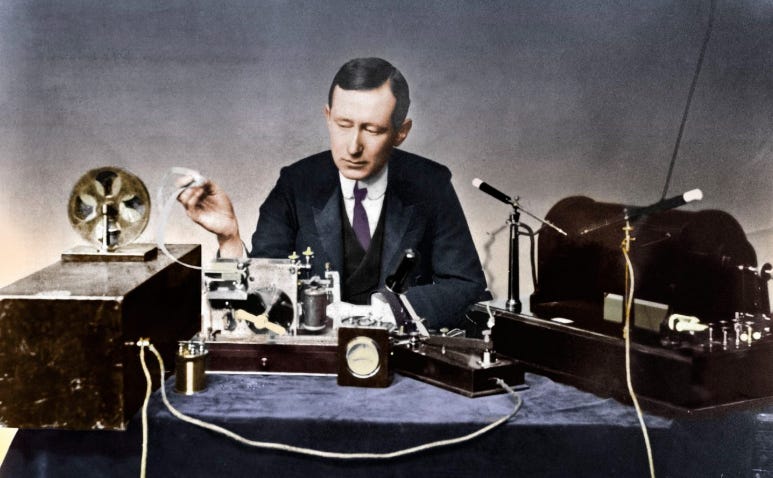
Because of radios, for the first time, communication wasn’t necessarily tied to a fixed location.
Over time, specialized radio systems became common in so many places, but these systems were very different from what we think of as mobile phones today.
Most radio networks were designed for specific organizations rather than the general public. Equipment was often large and power-hungry. Communication usually flowed through dispatch centers rather than allowing millions of individuals to call one another directly and there were technical limitations as well.
The radio spectrum is finite and only a limited number of conversations can occupy the same frequencies at the same time. Early systems struggled to support large numbers of users without interference.
Hardware presented another challenge: radios were bulky, expensive, and difficult to miniaturize. Batteries were heavy and offered limited operating time. Even if engineers could build portable wireless devices, scaling them for widespread public use was another problem entirely.
The Dream of Mobile Communication (1940s-1970s)
Mobile Telephones Before Cellular Networks
By the middle of the twentieth century, engineers had already started experimenting with a telephone that could travel with you.
In 1946, AT&T’s Bell System launched the Mobile Telephone Service (MTS), one of the first commercial mobile telephone systems in the United States. It allowed users to place telephone calls from vehicles using radio networks connected to the public telephone system.
Note: mobile communication and cell phones aren’t the same. Mobile telephones existed decades before cellular networks were introduced.
The Car Phone Era
The equipment was usually installed directly into vehicles. Radios occupied significant space inside the car, antennas were mounted externally, and the system often required dedicated power equipment to operate reliably.
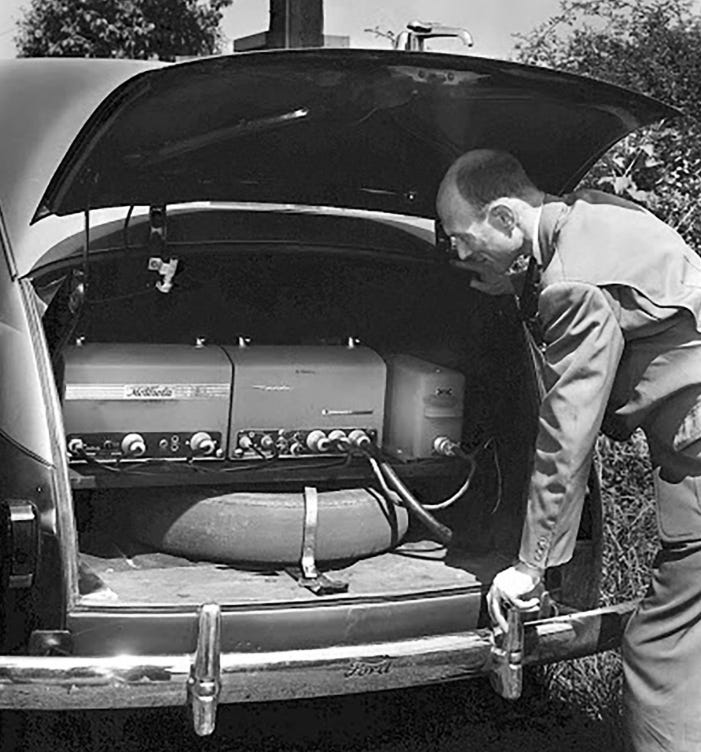
In many cases, this was the type of communication system that you built your vehicle around and the cost alone placed these systems out of reach for most people. Only a handful of powerful & wealthy customers made up the majority of users and even then, capacity remained extremely limited.
In other words, the bigger problem was scale.
A large city might have thousands of people interested in using mobile telephones, but only enough radio channels to support a small number of simultaneous conversations. In some areas, users had to wait for an available channel before they could place a call.
By the 1960s and 1970s, it had become clear that simply building bigger versions of existing mobile telephone networks wasn’t going to solve the problem and a different approach was needed.
Bell Labs and the Cellular Breakthrough
That approach came from Bell Labs.
Instead of treating an entire city as one giant radio coverage area, Bell Labs engineers proposed dividing cities into many smaller coverage zones called cells. Each cell would have its own radio equipment and frequencies. The same frequencies could then be reused in other cells located far enough away to avoid interference.
So, instead of trying to support more users with the same limited resources, cellular architecture allowed networks to reuse those resources repeatedly across different parts of a city.
Suddenly, supporting thousands or even millions of users became possible.
This concept became known as a cellular network, and it is where the term “cell phone” originates.
The cellular concept solved one of the biggest technical challenges facing mobile communication, but technology was only one part of the equation.
Building a nationwide mobile network required infrastructure, industry standards, and regulatory approval. None of those things happen overnight.
Throughout the 1960s and 1970s, telecommunications companies, engineers, and regulators were still trying to figure out how cellular networks would actually work at scale. Governments had to decide how radio spectrum would be allocated, which companies would be allowed to operate networks, and what rules would govern the technology.
In the United States, Bell Labs had proposed cellular architecture decades earlier, but regulatory approval moved much more slowly than the technology itself. Large portions of the required spectrum remained unavailable for years while debates continued between industry players and regulators.
Long story short, by the late 1970s, many of those pieces were finally starting to fall into place.