



Hey there 👋
In 2014, Facebook paid $2 billion for a company with roughly 75 employees.
That company had not shipped a single consumer product.
The founder was 21 years old. Its most famous product was a duct-taped prototype for a VR headset.
Fortunately, a video-games legend introduced that headset to the biggest gaming conference in the world.
And that’s when Mark Zuckerberg wrote that check.
This is the story of how Oculus revolutionized VR. It is the story of Palmer Luckey, a homeschooled kid who built over 50 VR headsets in his parents’ garage.
I’ll also talk about what happened after the check was cashed. The backlash and Palmer’s firing.
And lastly, we have to talk about Meta's billion-dollar losses in the metaverse.
Building Headsets in a Garage
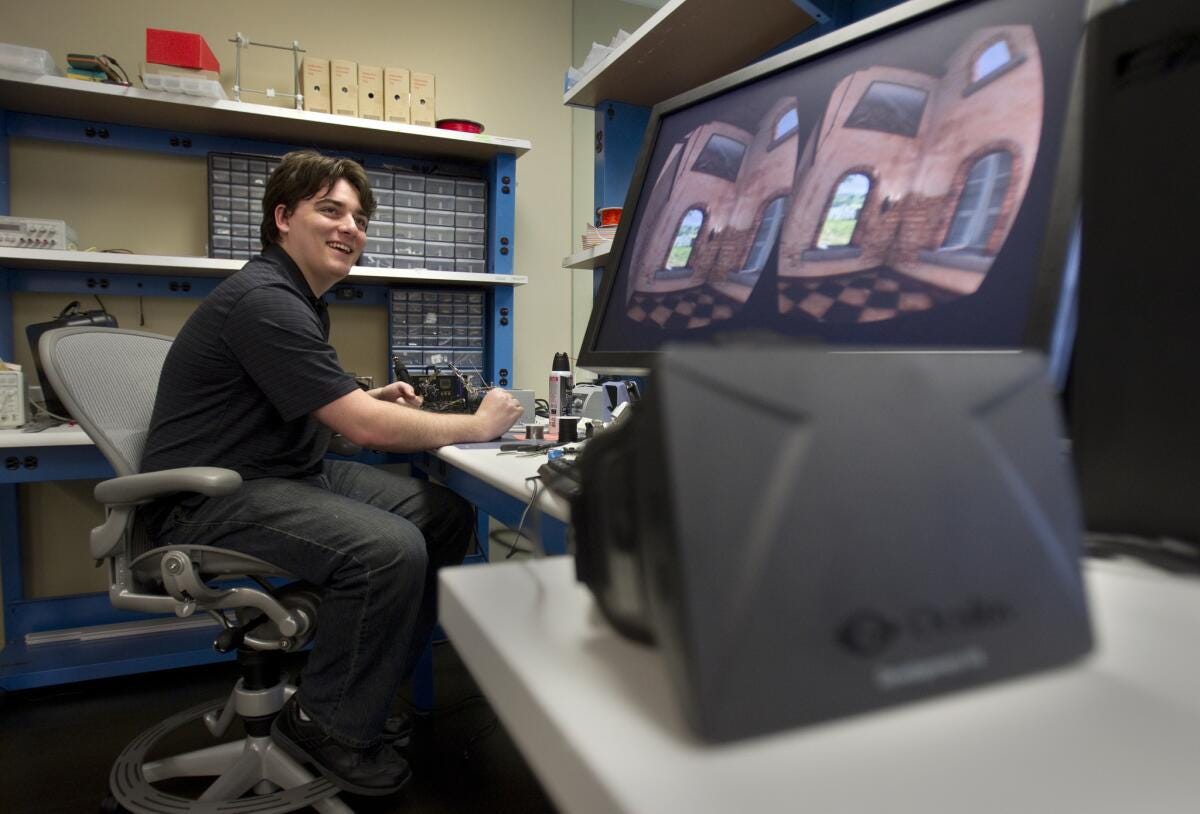
Palmer Luckey’s story is as interesting as the tech he has worked on.
He was born to a car salesman. His mom homeschooled all 4 of her kids. Palmer was the only one who never went back to regular school. He liked the flexibility too much.
From an early age Luckey was obsessed with electronics. He built high-powered lasers in his garage. He built coil guns.
He once electrocuted himself touching a grounded metal bed frame. He burned a gray spot into his vision cleaning an infrared laser.
Normal kids stuff, clearly.
To fund his experiments he fixed and resold broken iPhones. He worked as a groundskeeper and a youth sailing coach. He earned at least $36,000 this way before he was old enough to vote.
But his real obsession was virtual reality.
Luckey had spent years collecting old VR headsets. He had one of the largest private collections of VR hardware in the world at a time when he was a teenager living with his parents.
He had seen what VR was supposed to be and he was not impressed with what was available.
Every headset he owned had similar problems. They were heavy, expensive and didn't immerse you in a world as a good headset should.
So he decided to build his own.
Starting around 2009, when he was 16 or 17, Luckey began prototyping in the garage. He had a simple idea that most in the industry weren’t paying that much attention to.
Smartphone screens were getting really good really fast. They were getting sharper, brighter, and cheaper. What if you used one as the display inside a VR headset?
Then he had another idea. Instead of using expensive, bulky optics, what if you used cheap lenses and fixed distortions in software?
Both ideas together meant you could build a VR headset that was lighter, cheaper, and had a much wider field of view than anything else on the market.
For those who don’t know, the Field of View or FOV is how wide you could see inside a VR headset. A higher FOV means you’d feel more immersed.
Over the next few years Palmer built prototype after prototype. Over 50 of them in total. Each one refining his techniques a little more.
By his sixth generation prototype he had something he called the Oculus Rift. It had 3D, low-latency head tracking, and a 90-degree field of view.
Nobody outside a small VR enthusiast internet forum called MTBS3D had heard of it, but an interesting person was about to join the forum.
What Oculus Actually Was When It Started

In early 2012 Luckey was posting updates on MTBS3D, the niche online community where VR nerds compared notes and argued about specs.