
Hey there 👋
In 2015 AMD’s stock was less than 2 dollars per share.
The company was bleeding money. Their CPUs were getting destroyed by Intel. Their GPUs were losing to Nvidia. There were talks of bankruptcy.
Fast forward to today. AMD’s stock is near 450 dollars. They have arguably the best consumer CPUs.
AMD controls 30 percent of the consumer CPU market. Their server chips are taking share from Intel in data centers too.
Their GPUs still trail Nvidia but the gap is closing. The latest version of AMD’s upscaling technology is pretty good for most of us out here and FSR5 is going to be even more exciting.
People used to say AMD GPUs are not stable enough but today every major gaming console from Playstation, XBOX to handhelds like the Steam Deck, all use AMD GPUs.
And the next generation of consoles are also going to use AMD. Valve has confirmed that for their upcoming Steam Machine.
Meanwhile PlayStation and XBOX have leaks that they’re working with AMD for their next consoles.
This is the story of how AMD refused to die despite being smaller, poorer, and less powerful than both of their competitors.
It is also the story of one of the biggest comebacks in tech history. And why that comeback still might not be enough.
AMD Before Lisa Su
AMD’s story of the last decade revolves around her current CEO who took charge back in 2014.
She has been so instrumental in the company’s success that I think it’s best to see AMD as the one before she took over and after she became CEO.
AMD was founded in 1969 by Jerry Sanders.
Sanders was a former Fairchild Semiconductor executive who got pushed out in a corporate shakeup.
The company started in Sanders’ living room in Santa Clara with eight employees. The plan was simple. Make copies of other companies’ chips under license.
Back in the 1970s big companies did not want to depend on a single chip supplier. So AMD became a second source manufacturer.
They made Intel 8080 processors. They made more unknown chips. They made whatever customers needed them to make.
This worked for a while. AMD went public in 1972. In 7 years, their revenue hit 100 million dollars.
But they were always a follower, never a leader and Sanders knew this.
In a famous quote Sanders said “Real men have fabs” meaning that serious chip companies needed to own their own manufacturing.
So AMD built fabs. They invested in R&D. And in the 1990s they started designing their own x86 processors.
The K5 launched in 1996. It was AMD’s first internally designed CPU. It was not very good. Intel’s Pentium was faster.
The K6 in 1997 was better. AMD partnered with NexGen whose technology formed the basis of the K6. It competed well with Intel’s Pentium II in the budget segment.
But the real breakthrough came in 1999 with the Athlon.
Athlon Joins The Chat
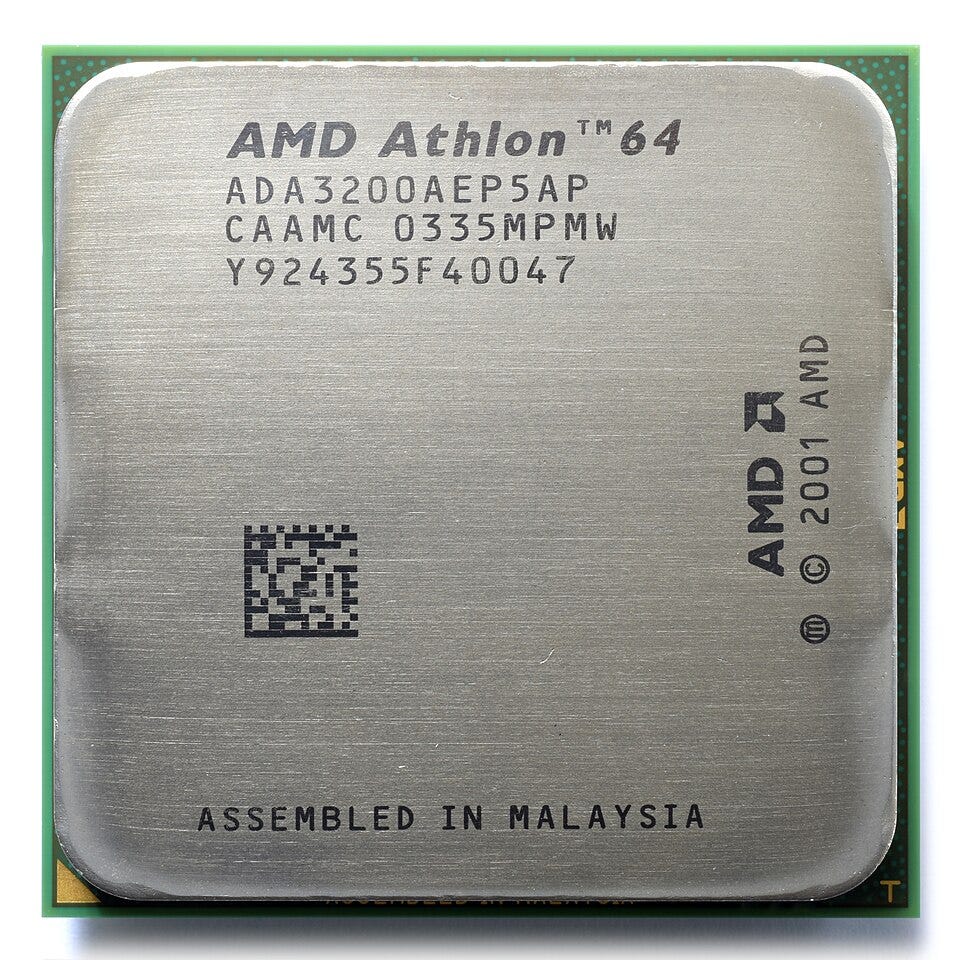
The Athlon was the first x86 processor to hit 1 GHz. AMD beat Intel to that milestone by a few months.
More importantly, the Athlon was genuinely fast. In many benchmarks it matched or beat Intel’s Pentium III. Suddenly AMD was not just the budget option. They were competitive.
AMD’s revenue grew to 2.8 billion dollars in 1999. Then 4.6 billion in 2000. The company was on a roll.
Then came the Athlon 64 in 2003.
The Athlon 64 was AMD’s most important chip ever. It introduced 64-bit computing to the x86 platform.
Intel was pushing Itanium as their 64-bit solution. Itanium was not x86 compatible. It required all new software.
Nobody wanted that. The industry wanted 64-bit extensions to x86 so old software would still work.
AMD delivered exactly that with AMD64. Intel eventually had to license AMD’s 64-bit extensions and rebrand them as Intel 64.
From 2003 to 2006 AMD had the better product. The Athlon 64 used less power than Intel’s Pentium 4. It ran cooler. And in many workloads it was faster.
Intel’s Pentium 4 architecture was deeply flawed. Intel had bet everything on clock speed. The Pentium 4 hit 3.8 GHz but it achieved that speed through a very long pipeline.
The Pentium 4 was fast on paper but slow in practice for many tasks. The Pentium 4 also consumed massive amounts of power.
Intel’s Pentium 4 could hit 115 watts at load. That is more than many GPUs.
AMD’s Athlon 64 consumed around 90 watts and was often faster. Enthusiasts and gamers loved it.
AMD’s market share hit 25.3 percent in Q4 2006 according to Mercury Research. That was AMD’s peak.
Then Intel struck back.
Intel Strikes Back With Core 2 Duo
In July 2006 Intel launched the Core 2 Duo. This was a completely new architecture. Intel had basically admitted the Pentium 4 was a mistake and started over.
The Core 2 Duo was everything the Pentium 4 was not. It was power efficient. It had excellent performance per clock. It scaled well with more cores.
And it destroyed AMD’s Athlon 64 in benchmarks.
By late 2006 Intel had regained the performance crown. AMD’s market share started dropping. Revenue peaked at 5.6 billion in 2006 then declined.
Intel also had way more money to spend. In 2006 Intel’s R&D budget was 5.9 billion dollars. AMD’s entire revenue was 5.6 billion.
AMD could not compete with Intel’s spending power. They needed something to change the game.
The ATI Acquisition
In July 2006 AMD announced they were buying ATI Technologies for 5.4 billion dollars.
ATI was Nvidia’s main competitor in graphics cards. They made the Radeon GPU series. They were roughly equal with Nvidia in market share at the time.
AMD’s vision was to combine CPUs and GPUs on the same chip. They called this an APU or Accelerated Processing Unit.
The idea made sense. Graphics were becoming more important for computers. Games needed GPUs. Video playback benefited from GPU acceleration.
If AMD could integrate a decent GPU with their CPU they could offer better value than Intel whose integrated graphics were terrible.
But the acquisition was a disaster from a financial perspective.
AMD paid 5.4 billion dollars. They paid 2.5 billion in cash and took on 2.5 billion in debt. The remaining 400 million was in stock.
This was AMD’s entire cash reserve plus massive new debt. And the timing was terrible.
2008 Financial Crisis

The 2008 financial crisis hit. PC sales collapsed. AMD’s revenue dropped from 6.0 billion in 2007 to 5.8 billion in 2008 to 5.4 billion in 2009.
AMD was burning cash. Their debt was ballooning. They had to pay interest on billions of dollars while losing money too.
In 2009 AMD lost 1.2 billion dollars. In 2011 they lost 1.8 billion. In 2012 they lost 1.2 billion again.
The company was slowly dying.
To survive AMD had to sell assets. The biggest sale was their chip manufacturing business.
In 2009 AMD spun off their fabs into a separate company called GlobalFoundries. The deal was structured as a joint venture with a company from Abu Dhabi.
AMD got 700 million dollars immediately and another 500 million later. This gave AMD cash to survive. But it also meant AMD no longer controlled their own manufacturing.
AMD went from being an integrated device manufacturer like Intel to being fabless like Nvidia and Qualcomm.
They had to rely on GlobalFoundries to make their chips. From the looks of it, they lost the ability to optimize manufacturing for their designs.
However, this is something that is going to flip the table as you read on.
Meanwhile on the product side things were getting worse. AMD’s CPU designs were falling further behind Intel. And their GPU designs were competitive but not winning against Nvidia.
AMD needed a new CPU architecture. Something to leapfrog Intel. They bet everything on a new CPU architecture from the ground up.
The CPU Architecture That Nearly Killed AMD
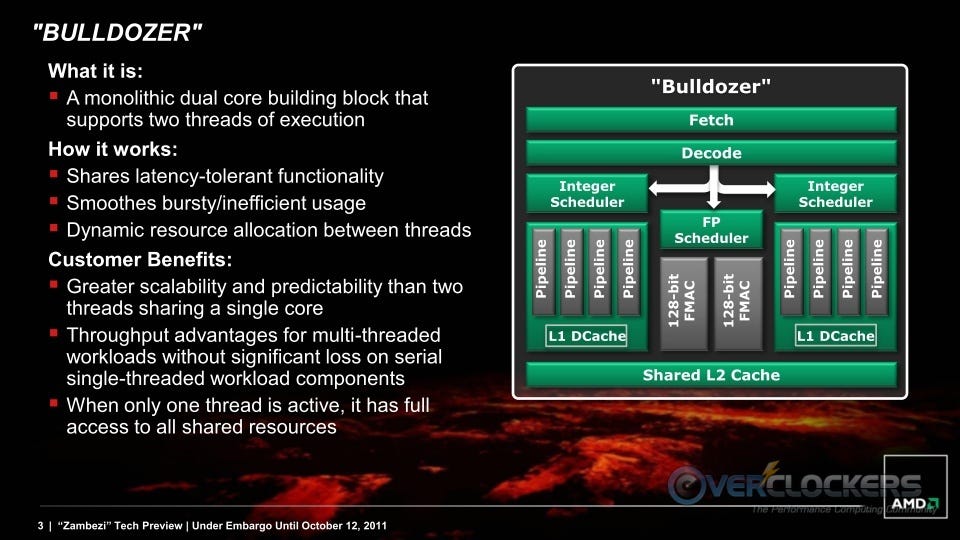
Bulldozer was supposed to save AMD. Instead it nearly killed them. The irony lol.
The architecture launched in October 2011 with the FX-8150 processor. AMD marketed it as the world’s first 8-core desktop CPU.
The problem was it was not really 8 cores. Not in the way most people understood cores.
Bulldozer used a module design. Each module had two cores but they shared a single floating point unit and they shared other resources.
AMD counted this as two cores. Technically they were right. But in practice two Bulldozer cores in a module performed more like 1.5 traditional cores.
Intel’s Core i7 2600K from early 2011 had 4 real cores. It destroyed the 8-core FX-8150 in most benchmarks.
In single-threaded tasks Bulldozer was terrible. The FX-8150 was slower than AMD’s own Phenom II chips from 2009.
Gaming performance was bad because games in 2011 mostly used 1-4 threads. Bulldozer’s theoretical 8 cores did not help.
Power consumption was high. The FX-8150 had a 125 watt TDP. Intel’s i7 2600K was 95 watts and faster.
Reviews were brutal too. AnandTech called it “disappointing.” Tom’s Hardware said “we cannot recommend Bulldozer.”
AMD’s stock dropped 30 percent in the months after Bulldozer launched.
But AMD doubled down on the architecture. They released Piledriver in 2012, Steamroller in 2013, and Excavator in 2015.
All of them were based on the same flawed Bulldozer design. Minor improvements each generation but the fundamental problems remained.
For five years from 2011 to 2016 AMD had no competitive CPU in the enthusiast or high-end market.
Their market share collapsed. In Q3 2015 AMD had just 17.7 percent of the x86 CPU market. Intel had about 82.3 percent.
On top of the Bulldozer disaster AMD faced a class action lawsuit.
Customers sued AMD claiming the FX processors were falsely advertised. The lawsuit argued that Bulldozer’s modules were not true cores.
AMD fought the lawsuit for years. In 2019 they settled for 12.1 million dollars without admitting wrongdoing.
But the reputation damage was done. Enthusiasts and gamers avoided AMD CPUs from there on and tech reviewers recommended Intel by default.
That’s partly where the GPU stability and excessive heat reputation comes from, for AMD. Ask an AMD user from that time and they will tell you about it.
AMD’s CPU business was dying and on the GPU side things were not much better.
Did you know? Intel quite recently had its own Bulldozer moment. Checkout this linked article for complete story of how Intel lost its processor crown.
Struggling GPU Business
AMD’s Radeon HD 7000 series in 2012 was competitive with Nvidia’s GTX 600 series.
Performance was similar but Nvidia had advantages beyond raw performance.
Nvidia’s drivers were more stable. Game developers optimized for Nvidia cards because that is what most gamers bought.
Nvidia had PhysX for physics simulation in games. AMD had nothing comparable.
Most importantly, Nvidia had CUDA.
CUDA was Nvidia’s programming platform for general purpose GPU computing. It launched in 2006 and by 2012 it was the standard for scientific computing on GPUs.
Researchers used CUDA for physics simulations, molecular dynamics, climate modeling, and early machine learning.
CUDA has been instrumental to Nvidia’s 5 Trillion dollar market cap. You can check this linked article for our in-depth coverage of Nvidia.
AMD’s equivalent was OpenCL. OpenCL was open source and theoretically better because it worked on any hardware.
But CUDA had a five year head start. The ecosystem was built around CUDA. Universities taught CUDA. Researchers published CUDA code.
AMD could not overcome that momentum and by 2015 AMD was in crisis on both CPUs and GPUs.
Their revenue had dropped to 4.0 billion dollars. They lost 660 million dollars that year. Their stock was at 1.61 dollars.
AMD was basically cooked to perfection :p
The Year AMD Almost Died
In January 2015 AMD’s market cap was just 1.5 billion dollars. Intel’s market cap was 160 billion. Nvidia’s was 11 billion.
AMD was tiny. And they were running out of money. The company had 785 million in cash at the end of 2014. They were burning through it quickly.
AMD sold their stake in a Chinese joint venture for 293 million dollars. They negotiated a new 2.25 billion dollar debt which bought AMD some more time.
The consensus was that AMD would either go bankrupt or get bought by a larger company. Samsung and Qualcomm were mentioned as possible options.
AMD needed new products. But new products take years to develop. And AMD did not have years of cash runway.
The person who had to solve this impossible problem was Lisa Su.
Lisa Su Takes Charge
Lisa Su initially joined AMD in 2012 as senior vice president of global business units. She was promoted to COO in 2014 and became CEO in October 2014.
Su had serious credentials. She earned a PhD in electrical engineering from MIT. She worked at Texas Instruments, IBM, and Freescale Semiconductor before joining AMD.
At IBM she worked on the Cell processor used in the PlayStation 3. She understood chip design at a deep level.
When Su became CEO AMD was losing 180 million dollars per quarter. The product pipeline was a mess. Employee morale was terrible.
Su made hard decisions fast.
First she killed unprofitable product lines. AMD had been trying to make chips for tablets and smartphones. They were failing badly.
Su shut down those programs. She cut 5 percent of AMD’s workforce. She focused everything on three areas: gaming, data centers, and embedded chips.
Second she bet on a completely new CPU architecture.
AMD had a team working on a clean-sheet design codenamed Zen. This was not a Bulldozer derivative. It was a fresh start.
Zen has been in development since 2012 under architect Jim Keller. Keller was a legend in chip design. He had worked on the original Athlon and the Athlon 64.
Keller left AMD in 2015 but the Zen team continued under Mike Clark and Suzanne Plummer.
Su committed AMD’s limited resources to Zen. If it failed AMD was probably done.
But Zen had a secret weapon that could make AMD competitive even without Intel’s manufacturing advantage - Chiplets.
The Ryzen Gamble
Traditional high-performance CPUs are monolithic which means that the entire processor is carved from one piece of silicon.
Want an 8-core CPU? You need a piece of silicon large enough for 8 cores plus cache plus memory controllers plus IO.
The bigger the silicon die the more expensive it is. And bigger dies have a worse problem: yield.
Yield is the percentage of chips that work after manufacturing. Not every chip on a wafer works. Some have defects.
The bigger the die the more likely it contains a defect. This is why Intel’s massive 28-core Xeon chips cost 3000 to 10000 dollars. The dies are enormous and the yields are terrible.
AMD could not afford to make giant monolithic chips because they did not own their own fabs. They had to pay TSMC or GlobalFoundries per wafer.
Low yields would make AMD’s chips too expensive to compete. So AMD’s engineers invented a different approach. Chiplets.
Instead of one big die you make multiple small dies. Each small die has a few CPU cores and cache. Then you connect the small dies together using a high-speed interconnect.
Small dies have better yields. And you can mix and match chiplets to make different products.
Need a 6-core CPU? Use one chiplet. Need a 16-core CPU? Use more chiplets.
This was revolutionary. No major CPU company had done this successfully before.
The challenge was the interconnect. If the connection between chiplets was too slow the CPU cores could not communicate efficiently. Performance would tank.
AMD spent years developing Infinity Fabric. This was their chip-to-chip interconnect technology.
Infinity Fabric had to be fast enough that cores on different chiplets could share cache and memory without huge latency penalties.
It also had to use reasonable amounts of power. The interconnect could not burn watts just moving data between chips.
AMD bet the company that Infinity Fabric would work.
The first Zen chips launched in March 2017 as Ryzen 7.
The flagship Ryzen 7 1800X had 8 cores and 16 threads. It cost 499 dollars.
Intel’s equivalent the Core i7-6900K had 8 cores and cost 1089 dollars.
Ryzen offered 90 percent of the performance for less than half the price.
Reviews were positive. Tom’s Hardware said Ryzen was “competitive with Intel’s best.” PC Gamer called it “the CPU competition we’ve been waiting for.”
But Ryzen was not perfect. Gaming performance was weaker than Intel because of Infinity Fabric latency and lower clock speeds.
Still Ryzen sold well. Enthusiasts who wanted high core counts for content creation and streaming bought Ryzen in huge numbers.
AMD’s CPU market share started climbing. From 17.7 percent in Q3 2015 to 19.6 percent in Q4 2017.
But the real target was not gamers. It was the data center.
Beating Intel At Their Own Game
Intel made most of their profit from Xeon server CPUs.
Data centers bought Xeon chips by the thousands. Prices ranged from 500 dollars to 10000 dollars per chip.
Intel’s data center group generated 19.1 billion dollars in revenue in 2016. That was 33 percent of Intel’s total revenue.
Intel’s Xeon chips are expensive and meant for enterprise but when bought used they can be excellent value for consumers.
AMD’s server CPU business was basically dead. Their Opteron chips based on Bulldozer were terrible. AMD had less than 1 percent server market share.
But with Zen AMD had a chance.
In June 2017 AMD launched EPYC for servers. These chips used up to four 8-core chiplets for a total of 32 cores.
Intel’s Xeon processors topped out at 28 cores and cost more than equivalent EPYC chips.
At first data centers were skeptical. But AMD kept improving.
As of writing this article, AMD controls roughly 40% of server CPU revenue.
AMD’s Switch To TSMC
One of the most important points in AMD’s story is their switch to TSMC starting with Zen 2.
Zen 2 used TSMC 7nm. Zen 3 used refined 7nm. Zen 4 in 2022 used TSMC 5nm. Meanwhile Intel was stuck.
Intel’s 10nm process was delayed for years. It finally shipped in 2019 but had yield problems and lower performance than expected.
Intel’s 7nm was delayed even longer. In 2020 Intel announced another delay and said 7nm would not ship until 2023.
By 2021 Intel was still manufacturing most chips on 14nm. A process they had been using since 2014.
AMD had a process advantage. Zen 3 on TSMC 7nm had better performance per watt than Intel’s chips on 14nm.
AMD’s switch to TSMC has been paramount to their later success. We went deep researching why TSMC is so important for companies like AMD and the rest of the world.
Cloud Providers Join In
And that’s when cloud providers noticed AMD
Amazon AWS launched instances using EPYC in 2018. Microsoft Azure added EPYC options in 2019. Google Cloud followed in 2020.
These companies do not make decisions lightly. They tested EPYC thoroughly. And they found it was cheaper and often faster than Xeon.
By 2021 AMD had 10 percent of the server CPU market. In 2 years that went to 23 percent.
AMD’s data center revenue grew from 1.7 billion in 2020 to 6.5 billion in 2023.
Lisa Su’s bet on chiplets and TSMC had paid off. AMD continued to dominate the consumer side.
Zen 4 launched in 2022 with the Ryzen 7000 series. These chips finally matched Intel in gaming performance while destroying Intel in multi-threaded workloads.
Zen 5 launched in 2024 and maintained the lead.
By 2025 AMD had 30.2 percent of the consumer x86 CPU market. Up from 17.7 percent in 2015.
AMD was making money again. In 2023 AMD’s revenue was 22.7 billion with net income of 854 million.
Their stock hit 180 dollars per share in early 2024. Up from 1.61 dollars in 2015.
But there was still one major problem. GPUs.
AMD vs Nvidia
While AMD was climbing back on CPUs their GPU business was still struggling.
AMD’s market share in discrete graphics cards was 19 percent in 2019. Nvidia had 81 percent.
By 2024 AMD’s share of GPUs had dropped to 12 percent while Nvidia had 88 percent.
AMD’s problem was not raw performance. AMD’s Radeon RX 6000 series in 2020 was competitive with Nvidia’s RTX 3000 series in raw performance.
In some games AMD was faster. In others Nvidia was faster. Overall they were similar. But Nvidia had an ecosystem advantage.
First, Nvidia had better software. Their GeForce drivers were more stable. Game developers optimized for Nvidia cards because that is what most gamers owned.
Second, Nvidia had features AMD lacked.
Nvidia launched ray tracing hardware with RTX 2000 in 2018. AMD did not have hardware ray tracing until RDNA 2 in 2020.
By the time AMD added ray tracing, Nvidia was already on their third generation of ray tracing cores with better performance.
Third, Nvidia had DLSS.
DLSS or Deep Learning Super Sampling launched in 2019. It used AI to upscale games from lower resolutions.
This lets gamers run games at 1080p internally but display them at 4K. Frame rates were much higher with minimal quality loss.
DLSS 2.0 in 2020 was genuinely impressive. It often looked better than native resolution because the AI model could reconstruct detail that simple upscaling would miss.
AMD’s response was FSR or FidelityFX Super Resolution. It launched in June 2021.
FSR was open source which was great. It worked on AMD, Nvidia, and Intel GPUs. Game developers could add it easily.
But FSR 1.0 was not AI-based. The result was that FSR 1.0 looked noticeably worse than DLSS especially in motion.
FSR 2.0 in 2022 looked much better but still lagged DLSS 2 in image quality.
AMD was always one or two years behind Nvidia. By the time AMD matched a Nvidia feature Nvidia had moved on to the next thing.
Fourth, Nvidia dominated AI.
The AI boom that started in 2022 made Nvidia’s GPUs essential for training large language models.
Every AI lab wanted Nvidia H100 GPUs. These chips cost 30000 to 40000 dollars each and were in such high demand that delivery times stretched to months.
Nvidia’s data center revenue was 18.4 billion in fiscal 2023. It hit 47.5 billion in fiscal 2024. And it exploded to over 100 billion in fiscal 2025.
AMD had GPUs for AI. On paper they were competitive with Nvidia but nobody wanted them.
Because the problem was software. Every AI framework was built on CUDA. PyTorch, TensorFlow, JAX all used CUDA.
Researchers had years of CUDA code. Universities taught CUDA. Every AI tutorial assumed Nvidia GPUs.
AMD’s ROCm was supposed to be their CUDA equivalent. But ROCm was buggy and poorly documented for years.
By the time AMD fixed ROCm the ecosystem had moved on. Nobody wanted to port their code from CUDA to ROCm.
Some companies bought AMD MI300 chips to hedge against Nvidia supply shortages. But given the choice everyone picked Nvidia.
AMD’s data center GPU revenue was around 400 million in 2023. Nvidia’s was 47.5 billion.
On gaming GPUs the situation was similar. AMD had 12 percent market share. Nvidia had 88 percent.
AMD was getting crushed still but last year something has changed.
Is AMD Finally Catching Up to Nvidia?
Last year AMD launched the latest version of their upscaling technology - FSR 4.
FSR 4 was completely different from FSR 3. AMD rebuilt it from scratch using machine learning just like DLSS.
The FSR 4 model was trained on thousands of game frames at multiple resolutions. It learned how to reconstruct high resolution detail from low resolution input.
Reviews of FSR 4 were positive. Digital Foundry said it was “the closest AMD has come to matching DLSS.”
Tom’s Hardware called it “finally competitive.”
In side-by-side comparisons FSR 4 on RDNA 4 was very close to DLSS 3.5. Not quite as good but close enough that most people would not notice the difference.
For the first time since 2019 they had an upscaling solution that genuinely competed with Nvidia.
In March 2025 AMD launched RDNA 4 with the RX 9070 XT. This GPU was positioned as a midrange card at 599 dollars. And it competed with Nvidia’s RTX 5070 Ti at 749 dollars. (Though actual end prices may differ due to market conditions.)
Raw performance was roughly equal and ray tracing gap was smaller than previous generations.
With FSR 4 enabled the RX 9070 XT often matched or beat the RTX 5070 Ti in overall gaming performance.
On the data center side AMD launched its MI355X accelerators in mid-2025.
Some big customers are finally willing to try AMD for AI.
Meta announced in January 2026 that they bought thousands of these chips for Llama 4 training. Microsoft said they were deploying MI chips in Azure.
It is not enough to challenge Nvidia’s dominance. Nvidia still has over 90 percent of the AI accelerator market.
But AMD’s data center GPU revenue hit 3.5 billion in fiscal 2025. Up from 400 million in 2023.
Progress is slow on this front but it is real.
Gaming Consoles Keep AMD Alive
There is one part of AMD’s business that does not get headlines but matters a lot for the company and that is console chips.
PlayStation 5 and Pro use a custom AMD chip.
Every Xbox Series X and Series S uses an AMD chip.
The Steam Deck uses an AMD chip.
Valve’s upcoming Steam Machine uses an AMD chip.
Sony and Microsoft chose AMD because AMD was the only company that could provide competitive CPU and GPU in a single package.
Intel had great CPUs but their integrated graphics were mediocre. Nvidia had great GPUs but no x86 CPU license.
Only AMD could do both.
The console business does not have great profit margins. Sony and Microsoft negotiate hard on price because they buy millions of chips.
But it provides stable revenue.
AMD’s gaming segment which includes consoles and semi-custom chips generated 6.2 billion in revenue in fiscal 2023. That was 27 percent of AMD’s total revenue.
More importantly consoles kept AMD’s GPU architecture relevant during years when they were losing badly to Nvidia on PC.
Game developers had to optimize for AMD GPUs because the PS5 and Xbox use AMD graphics. Those optimizations helped AMD’s PC GPUs run games better.
When Valve launched the Steam Deck in February 2022 they chose AMD for the same reason. AMD could provide CPU and GPU in a compact power-efficient package.
The Steam Deck was a huge hit. Valve sold millions of units. It proved handheld PC gaming was viable.
Now Valve is working on the Steam Machine. This is essentially a console-like PC for the living room running SteamOS.
It uses an AMD chip. If it succeeds AMD gets another high-volume customer.
Consoles will never be a huge profit driver. But they provide a floor. A baseline revenue that keeps AMD stable when CPUs or GPUs are struggling.
For a company that has nearly gone bankrupt multiple times, stability is invaluable.
Can AMD Actually Win or Just Survive
At the time of writing this, here is how things are for AMD.
On CPUs they are winning. AMD has roughly 30 percent consumer market share and 24 percent server market share as of 2025.
AMD’s EPYC processors are taking consistent share in data centers.
Intel is still bigger. Intel’s 2025 revenue was around 50 billion. AMD’s was around 26 billion.
Intel’s manufacturing is still recovering from years of delays. Their 18A process launched in early 2026 but yields are still ramping.
AMD is using TSMC’s 3nm and soon 2nm. Those processes are proven. AMD does not have to worry about manufacturing.
On GPUs AMD is losing but improving too. They have 14 percent of the gaming GPU market. Nvidia has 86 percent.
FSR 4 closed the gap with DLSS. RDNA 4 is competitive in the midrange. But Nvidia’s high-end GPUs are unmatched.
In AI accelerators, Nvidia is the only king with over 90 percent market share. AMD is not going to beat Nvidia in AI anytime soon. Maybe not ever.
But AMD does not need to beat Nvidia to survive. They just need to capture 5 to 10 percent of the market.
If AI spending hits 300 billion per year by 2028 and AMD captures 8 percent that is 24 billion in revenue. That would be transformative for AMD.
AMD has survived for 57 years. They have outlasted countless competitors. Cyrix. Transmeta. Via. All gone.
AMD came back from the brink in 2015. They could do it again if needed. But surviving is not the same as winning.
AMD’s goal is not to be the biggest. It is to be good enough to stay in the game.
Lisa Su took a company worth 1.5 billion dollars and turned it into a company worth close to a trillion dollars in 14 years.
She killed the losing mobile business. She bet on Zen when everyone thought AMD was finished. She committed to chiplets when everyone said monolithic was the only way.
She partnered with TSMC when AMD’s own fabs were failing. She focused on servers when everyone said AMD could never compete with Intel in data centers.
AMD could have been bankrupt a long time ago but it is still here.
The Underdog That Must Fight
As someone who’s writing this article on an AMD GPU, I want the company to exist.
Look, I see AMD as an underdog that fights well above its weight. I mean this small company is fighting the two behemoths in the CPU and GPU domains, all at the same time.
AMD has to exist, not because it may just overtake Nvidia but because it keeps Intel and Nvidia on their toes.
These big companies don’t have much incentive to compete when the underdog disappears.
Ryzen is among the biggest reasons why Intel is redeveloping its manufacturing process and designs because they know they’ve lost to Ryzen.
AMD doesn’t have the best technology in all its domains but it doesn’t have to have that. If it keeps up a good fight, it has done its job.
AMD learned their lessons the hard way.
They lost focus in the 2000s trying to do too many things. Mobile chips. Low-end graphics. Bulldozer’s flawed design.
Under Lisa Su AMD became focused. Three markets: gaming, data centers, embedded and that focus is what has saved them.
The next 10 years will test whether AMD can move from survival to actual victory.
Can they take 40 percent of the CPU market? Can they get to 25 percent of GPUs? Can they grab 10 percent of AI?
Nobody knows. Maybe not even AMD but I sincerely hope they keep fighting.
As always, your feedback is what improves our writing here at SK NEXUS. We’re a small publication funded by no one but ourselves.
Please feel free to share the publication to that curious mind who would find it useful.


