



Hey There 👋
This article was originally a companion piece to the Episode # 21 of Tech Made Fun.
I decided to freshen it up a bit and republish it here. Still has great snippets about the current eCommerce landscape in Pakistan.
In this article, I largely discussed the digital shopping experience from the POV of an average person who wants to shop online.
I started with the digital shopping options we have in Pakistan, the different payment methods we have access to and which ones should be prioritized.
A big chunk of this piece was to discuss how to avoid fake products, bogus reviews and scams when shopping online as more and more platforms become complicated for our average Bashir.
Marketplaces & Direct-to-Customer
The digital shopping landscape in Pakistan and across the globe can generally be divided into two main spheres - Marketplace and Direct to Customer.
Like in the US, there are players like Amazon and eBay which act as marketplaces where multiple sellers from different categories list their products to be sold.
And then there are specific brands selling their stuff like Apple selling its own products or Nike selling their shoes on their own websites.
What that means is that there are mostly two types of shopping avenues for an average consumer.
In Pakistan, platforms like Daraz and Olx are marketplaces where many sellers can list their products, while brands like Gul Ahmed or Khaadi are direct-to-customer because they can sell their products directly to customers, without any intermediary marketplace.
Common Payment Methods in Pakistan
A significant population of Pakistan’s economy is undocumented which means that a large population doesn’t have bank accounts or debit cards that they could use for purchases.
We won’t get into that since there are a lot of reasons behind this. If you’re interested, check out Episode # 18 of TMF.
Since a lot of people here don’t have bank accounts and debit cards, COD (Cash on Delivery) is the most popular payment method in Pakistan. Unlike developed countries where digital payments are encouraged, in Pakistan, they are largely looked down upon.
Majority of Pakistanis don’t trust digital payments and that’s one of the factors that led to COD being the most popular payment method in online shopping here in Pakistan.
Other than COD there are payment methods like Easypaisa and JazzCash but more than purchases they are popular for transfers. You should know that some sellers charge an additional fee on COD orders.
Digital Wallets
Now, the majority of Pakistanis don’t have access to their own bank accounts but digital wallets like Easypaisa, Jazzcash etc are common in urban as well as rural areas.
Most of these services don’t require hefty documentation or branch visits and this ease of account opening and transacting has led to a large amount of the population using them for their transactions.
Other than microfinance banks mentioned above, newer fintech players like Sadapay and Nayapay are getting more common in urban centers.
Through them, more people have access to debit cards that could be used for online payments. Digital wallets are getting traction in cities but they are yet to penetrate into rural areas.
Escrow Approach
Escrow is such a setting in online shopping where there is a third party between seller and the customer. This third party ensures both sides fulfill their side of the deal. Imagine it like a third friend that holds the cash until both the buyer and seller are satisfied with the transaction.
Pros of Escrow
The escrow approach has some benefits to direct-to-customer shopping, where the money is safe with the third party which ensures the buyer and the seller are doing what they have to do.
This introduces a level of security in the transaction and makes it harder for one side to rip off the other, be it the buyer or the seller. On the contrary, the Direct-to-Customer approach lacks this level of security and the seller is at the mercy of the buyer.
Here’s an example to understand better:
Imagine buying a kurta from Gul Ahmed. You paid the amount and the Kurta arrives a week later only for you to find that it doesn’t fit you or it has some marks, You want to return it but now it’s up to the seller (Gul Ahmed in this case), They can either accept it or deny it right away, they can do that since there’s no overseeing entity or regulation.
Now imagine, you ordered the same Kurta from a marketplace like Daraz that loosely functions as an escrow. Here Daraz isn’t going to release the payment to the seller unless you are satisfied with the product till a set amount of time. If you find that the Kurta is not a good fit, you can just initiate a return.
In a country like Pakistan where Consumer Protection laws don’t exist, escrow services are the better choice for the average consumer and seller alike since it protects both of them in the end.
Website and Customer Reviews
Reviews play an important role in influencing what you and I buy. Selecting a product with 5 star rating over one with just 3 stars seems common sense right?
Well It depends. In Pakistan, unfortunately, online sellers largely bluff about reviews on their products. The reviews could sometimes be the website owners using bots or a person writing reviews on their products to rank them on top of search results.
Scammers understand that the yellow shiny star rating is what would hook amateur customers into their scams. That’s why they try their best to bluff their customers into showing that.
A useful approach here to filter fake reviews is to focus on the amount of ratings than the star.
A product with 4 stars and 300 reviews should be prioritized over one with a 5 star rating and 20 reviews. The amount of reviews are generally a more accurate representation of buyer’s sentiment of the product.
Experience based products
Reviews should be an important factor while considering buying a product but it should not be the most important one especially when you’re buying an experience based product.
Audio and visual devices commonly are subjective to the user. I may not like the sound of a certain headphone while the other person would love it.
Different people have different expectations from the products and in such a scenario Customer reviews should not influence your opinion of the product but rather the opinion of that specific listing being sold by the seller.
For in-depth reviews on Experience based products you can google a lot of different perspectives to make up your mind on the product you wish to buy.
Fake Discounts
In Pakistan, online shopping isn’t as mature as other countries. Buyers simply don’t have much information on the fake stuff sellers come up with and that is the vulnerability scammers and unethical sellers exploit.
You would often come across an item that has a 50% discount with a time ticker next to it. The cut down price would psychologically impact you to hit the Buy Now button and that’s what a new buyer would do.
But a mature buyer who has had much experience in buying online would copy the item’s name, google it and look for its prices at other outlets or even international markets to gauge the right price for it and that’s when they’d realize between a fake and a genuine discount.
A good approach is to just google the price of the item in the international market.
Let’s say you see a headphone on a local website going for 15K PKR on discount while the seller mentions the original price to 30K PKR. Just copy the name and model, look for it on Amazon, convert the price to PKR and see for yourself if the price is fair or not. In most cases here, It won’t be.
Take the image below for an example:
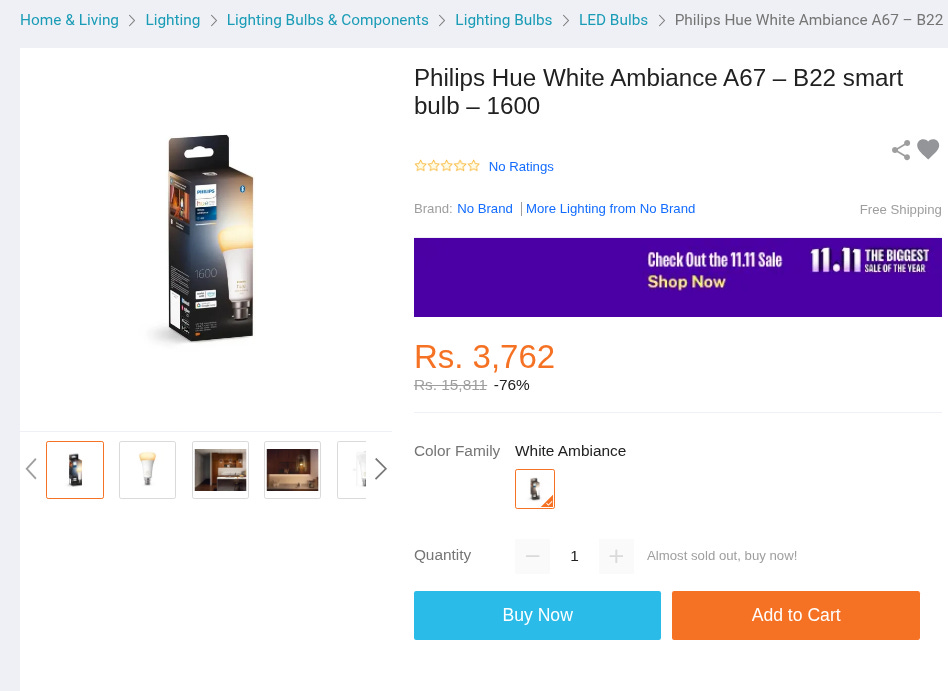
This is a smart bulb that has been for 3.7k PKR for 3 months now. I know this because it was in my cart all this time :p
If it was your first time on Daraz, you’d actually believe this fake 76% discount, but if you do google it a little you’d get to know about the real price that isn’t 15k PKR.
Pro Tip: If you really want to test a discount, add the product to you Wishlist and observe over time. Oftentimes you will see that there is no actual discount on it and it is at that price all the time.
Product Images
Most of the products you see on local websites aren’t made in Pakistan. They’re mostly imported from countries like China, Dubai or other countries. The majority of sellers here list the stock picture that they receive from where they bought the item from instead of taking the picture themselves.
A trained eye could just look over the picture and tell if it’s taken by the seller himself or not but for an average person, they could just copy that image, paste it to google and see if multiple sellers have the same picture, If there are then you have your answer and that’s a reason to be a bit more cautious.
Other than using stock images, sellers often have misleading images. That’s especially true for cheaper products lets’ say under 10K PKR. In that case, a buyer shouldn’t focus that much on the picture itself but try to find out real reviews from people who have bought the item.
With more and more sellers using AI for their images, this issue is becoming increasingly harder as time goes by.
Out of stock Items & WhatsApp
Out of stock banner is another pain that a buyer has to go through. As discussed earlier, Pakistani eCommerce stores mostly import items from other countries.
Most countries around the world trade in USD instead of PKR and the economy of Pakistan doesn’t help with that. Due to this, sellers don’t have a lot of stock in hand and they only order once the buyer places an order.
This is where another pain hits for the buyer. Most sellers who have to import stuff don’t mention prices on their website or sometimes they have the old price mentioned on the page and ask you to Whatsapp them before placing the order and once you ask them for the current price it usually comes up with an increase.
Buying from such sellers also takes time since they also have to place the order on their end. In this case, if something needs to be bought urgently, the seller with stock in-hand wins.
Daraz
Backed by the Alibaba Group, Daraz is Pakistan’s biggest online marketplace with hundreds of categories and thousands of products to choose from. It is also the most popular platform for buying stuff online.
Now Daraz has some real good sellers ranging from flagship stores to Daraz Mall sellers but also some really smart scammers that try their best to fool customers. There are mostly two types of sellers in Daraz – DMall Sellers and Normal Sellers.
Anyone can be a normal seller on Daraz but Daraz Mall sellers are verified by Daraz for offering authentic products. Such sellers are less risky to buy from since they are verified by the platform itself for selling the genuine product along with warranty and better return options.

No Brand
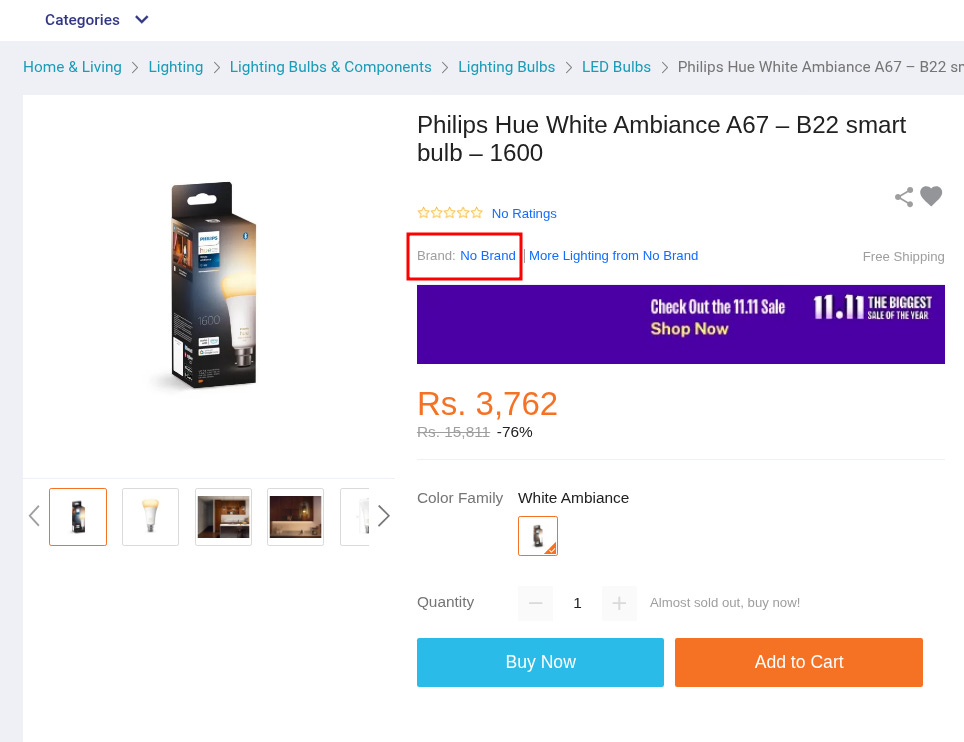
From time to time I see a seller selling something for 25-35% less price. All of the details on the product listing would be the same except just one thing. In the product description the seller would mention the brand as ‘No Brand’ but the seller does try to fill in the company name in the Product title though it would also be written in a way to deceive customers.
A common pattern I see is that such sellers don’t have any ratings on the product itself or even if it does they look unreal. Such a listing is always a scam.
Let’s explain with an example
You want to buy a Playstation 5 on Daraz, You see a Daraz certified seller selling it for 200K PKR while you see another seller selling the same Playstation 5 with the same specs and even the same pictures but for 120k.
You compare the listing and most of the stuff is the same except that the 120k has No Brand mentioned in the description. That should be your red flag that it’s a scam.
Now, that isn’t to say that any seller that has ‘No Brand’ on its listing is a scam. Many times the sellers are just lazy even when they have original products. But whenever you see ‘No Brand’ and an impossibly low price, just run away.
Closing Thoughts
The Pakistani online shopping space is filled with a large number of scams and sellers trying their utmost to deceive the customer, especially the average consumer who doesn’t have much information to make an informed decision at their disposal.
Lack of information on the subject is the number 1 advantage these scammers and unethical sellers have.
But an average Bashir could defeat many of the scams, fake discounts, robot reviews and all that if he just puts in a little common sense and simple googling to his use. It’s just that simple.
If the price for something seems too good to be true, then usually that is the case
Prioritize local marketplaces like Daraz that have payment protection and good return policies
Use cards for purchases whenever you can and use cash only if you have to. Some banks even allow reversing a transaction on some cards if the user reports a scam or false transaction
Don’t fall for those 50% cut down prices, instead look for the product’s real price on google, search it on different international sellers and see for yourself if the discount is real or not
Reviews could be deceiving, be it a marketplace like Daraz or a direct eCommerce site. Don’t just rely on the seller or the customer’s word and do your due diligence especially for experience based products. Prioritize the amount of reviews more than the star rating on a product
I hope reading this you have a better understanding of digital shopping here in Pakistan and how you can prepare yourself against marketing bluffs and scams. The stuff we discussed in this piece largely applies to most places with some tweaking.